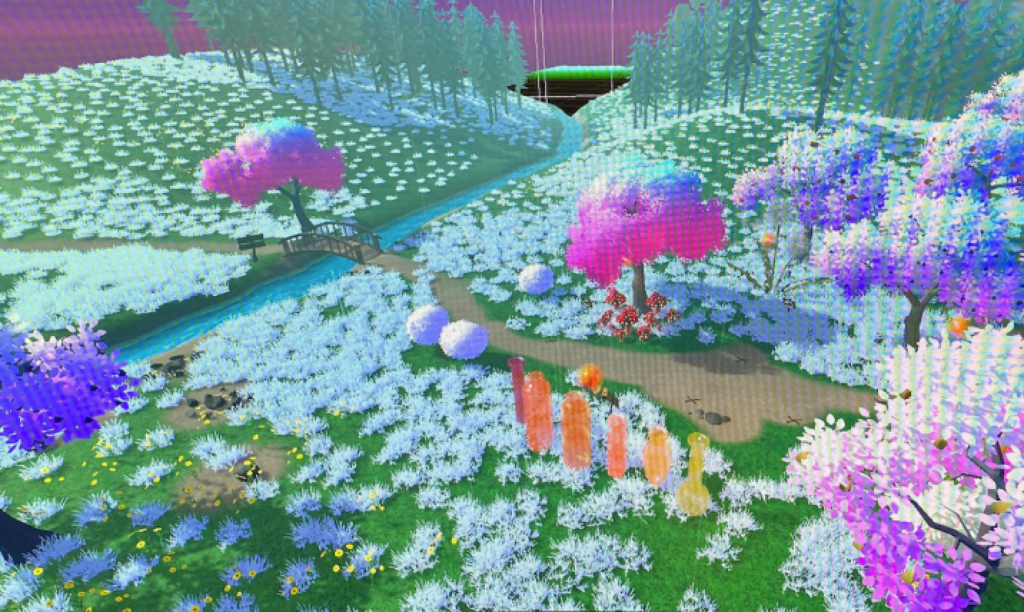
Below are the final four images from Mind’s Eye VR I have selected to be printed for the showcase handbook that I feel best represent my project:

SAM MUKHERJEE MAAI LEARNING LOG
REFLECTIVE JOURNAL FOR MA APPLIED IMAGINATION 2021
Below are the final four images from Mind’s Eye VR I have selected to be printed for the showcase handbook that I feel best represent my project:
In assessing my experience on the MAAI course holistically as well as preparing for potential external stakeholders’ enquiries during the online and physical exhibitions, I created a list of answers to the following questions from a previous tutorial:
How did you arrive at your question and your research methodology?
I arrived at my question through a process of multiple interventions as well as speaking to industry experts to identify the gaps in the existing market. This process took several months and rounds of thorough research and development within the fields of VR, neuroaesthetics and the mindfulness- meditation industries. My research methodology consisted of existing secondary research (journals and articles) in the field, as well as action research where I interviewed and collaborated with stakeholders in the field to further my understanding of the project as well as to devise the final shape of my platform. Read More Here.
Can you define your research methodologies, and their relationship to your question?
My research methodologies, both primary and secondary, have been critically evaluated to seek an answer for my question. All existing secondary research has been backed up with more articles that support existing and new findings, and primary research has been cross- referenced with the existing body of secondary sources. Though my question has taken different forms since the start of the course, my existing bibliography has played a vital role in streamlining the field of research as well as in consolidating newer iterations of the research query.
Are you sufficiently aware of the context and existing state of understanding of your question within your field of enquiry?
At the moment, I feel comfortable enough to evidence the creative choices within Mind’s Eye VR and am able to provide theoretical evidence on each aspect of the platform that is backed by the existing body of research within the field. However, keeping in mind that both VR- mindfulness and the field of neuroaesthetics are relatively new areas of research, there is limited data available in the current academic pool. Moreover, finding a gap in the research and creating an intervention to test means that the benefits from my research are based on a theorised hypothesis, rather than having been tested at a higher level (eg. clinical trials). Thus, it is important to establish that more research needs to be contributed within the field in order for its contextual understanding. Read More Here.
Who has given professional feedback?
To date, my intervention stakeholder group (n=23) has consisted of coursemates, creative professionals in my network, and external experts within the VR, Film and Television industries aged between 18-50. They include freelance creatives within the AR/VR industries, experts who have worked within VR-mindfulness platforms, as well as lecturers who specialise in VR at the university. Read More Here.
What other kinds of feedback have you received?
From my personal tutor, I have also received feedback in the importance of having an identity for my intervention, from generating a title to the branding and presentation during the exhibitions and beyond the course. This has been really helpful in packaging the way I want to pitch and share my project with external stakeholders in future.
Have you incorporated the feedback you have received into the iterated model/s of your question and intervention?
Yes, as the incorporation of feedback has been vital to moving the project forward, and often opens a new direction of discussion for new iterations of the intervention. Read More Here.
Have you researched in an ethical way?
Yes, as I have taken to account the ethical considerations for research, specifically in the collection of data and how feedback is used. Read More Here.
What has changed as a result of your research? What next?
As a result of my research, I have not only been able to identify impressionist environments as a potential way forward for VR- mindfulness platforms, but have also identified new areas of exploration from the feedback my intervention has received. My next steps would be to explore the new areas I have found and conduct further iterations of interventions. Read More Here.
The title I have chosen for my intervention is Mind’s Eye VR.
By dictionary definition, the “mind’s eye” refers to the hypothetical site of visual recollection or imagination, if you see something in your mind’s eye, you imagine it and have a clear picture of it in your mind.
I found this to be the most appropriate title for an impressionist VR mindfulness experience, as I feel that it best encapsulates what the project is about. I also wanted to keep the logo and text as simplistic as possible, in order for audiences to easily understand the context of my project.
Below are some logos and branding that I have built which will be used to showcase my intervention in the exhibitions online and on- site, as well as act as a visual representation of the project moving forward.
When reflecting upon my personal learnings from the year and the differences in myself not only as a researcher but as well as a creative in comparison to the start of the course, I found a few notable points that changed my outlook on evaluating my work.
Firstly, I feel as I have finally overcome the impostor syndrome that I recurrently mentioned at the start of Unit 2, as I have achieved the goals I had set for myself and managed to create an intervention with the power to change and remodel traditionally existing systems of mindfulness. This could either be because I have been more confident in approaching stakeholders and asking for help and feedback, because I have done more secondary research into the field, or because I have found a way to reshape the value in my project by being adaptable in my method for creating change (or a combination of the above). I have also found a greater purpose in academic research and how it continuously evolves as opposed to stopping after having found an answer, and realised that the emergence of new questions after having completed an intervention is not something to be afraid of, but rather an assurance that something has worked in order to provoke more knowledge to be found – something I had a completely different mindset to at the start of the course. I have also realised that when my creative intention has been within creating change for good, more stakeholders and people I tell about my project have shown interest and involvement in my journey as a result of my own passion for the topic translating through naturally, and that it is often not necessary to know everything about a certain topic but rather the interest itself that conveys to stakeholders that this is a “serious” project.
The role of action research has also had a significant effect on my work- ethic as a creative, as I have become better at time management and project management by understanding how to prioritise my research and holistically reflecting on the key points from primary and secondary research and stakeholders that help me move forward with my interventions. Action research has also allowed me to test the hypotheses derived from my secondary research and given reality to academic concepts- which has been extremely exciting. At the start of the course, I was afraid to conduct much primary research at the risk of either messing up or contradicting existing secondary research (and thus seeing it as a failure), however I have now understood that even an intervention that provides feedback which contradicts an initial hypothesis can add value to the research field. I have also become more confident in approaching external stakeholders and openly admitting the gaps in my research and where I need help, which has led to discussions that have immensely improved my quality of research and provided pathways forward for exploration. Overall, I think the role of failure has had the biggest learning edge on me, as I can now understand that the only type of failure that is truly disadvantageous within research is the failure to take action and be afraid of not reaching an “end- goal”. In my own career moving forward, I will definitely take the learnings from my research process and actively apply them to my professional life, as I see the “action” method and outlook as a huge asset within the creative industries.
In answering my research question of how impressionist theory can inform naturalistic design within stylised Virtual Reality – based mindfulness environments, I was able to conduct an intervention that led to the results of impressionist design showing positive effects on VR- based mindfulness environments, whereby 83% of participants found the experience to have improved their mood in comparison to the way they felt prior.
Alongside the gaining of this new knowledge, I also received extremely valuable feedback on the experience that opened the doors for further avenues of research and potentially further iterations of the intervention that could be tested.
Primarily, it is important to consider for future iterations that impressionist design is highly subjective, and as the name implies, the impression of the creator (myself) of what the design (the VR world) should be. Thus, it could be extremely beneficial to explore individual impressions of a mindfulness space that is created by the user themselves, in order to cater to each end- user. Perhaps future versions of the experience could include a world- building phase where each user could create their own mindfulness space. A case study I looked at for considering this possibility were the SIMS video games, where the user essentially builds the world around them. This would not only allow the mindfulness experience to be truly personalised, but also give end- users the freedom to choose a space in which they feel comfortable in (eg. forest, garden, library, fireplace, bedroom, etc.) and be able to feel a sense of comfort knowing that the space is one that is uniquely for them.
Another iteration of the intervention as mentioned in previous findings could include harnessing the in- built technology within the HTC VIVE Pro VR systems, whereby the inclusion of haptic and sound technology could help to increase the range of exercises that the experience provides. A key piece of recurring feedback in my intervention was regarding the limitations of mindfulness solely through breathing exercises – as not everyone is able to be mindful only through breathing techniques. Looking back, I also realised that I myself need a secondary form of mindfulness, whether it be through painting, or playing an instrument, or speaking to a friend.
A case study I looked at through exploration on the Steam VR Platform was TiltBrush by Google, where the haptics of the controller are used to aid in painting/sketching/writing on a canvas or a whiteboard. When experiencing the platform in VR myself, I was really impressed by the vibrations on the controller (haptics) when I changed from a pen to a marker on a (virtual) whiteboard, or when I picked the string of a (virtual) guitar, namely in how realistic the vibrations were without being overbearing or startling in any way.
As art therapy has already shown in research to have extremely promising results within meditation (Source: Gambis 2015), including a type of activity where the end- user is able to be creative within the experience would be an extremely beneficial addition to the next iteration of the intervention.
Furthermore, I realised that while impressionist theory had been the most widely- studied fine art practice in the field of neuroscience (thus having a significantly large research pool), it would also be interesting to observe VR- mindfulness spaces in different art styles, such as surrealism, cubism, etc. and analyse the results.
Lastly, it is also important to consider logistical reiterations moving forward, such as having the experience in different languages, catering to the needs of a neurodivergent end- users, as well as general accessibility requirements of certain users (eg. some may require an audio guide, some may want the breathing exercises to last more than 3 repetitions, some may want a variety of (more and less) exercises that are time- sensitive, etc). As I have placed so much emphasis about wanting mindfulness to be accessible and for end- users to have agency on their mental- wellbeing throughout my intervention, this would definitely be a crucial next step for me to follow- through on my project aims for the future.
In feedback that I have received from both my personal tutor as well as my stakeholders, it would appear that my research question seems legible (and understandable) when written down, but when verbally communicated it seems too wordy and takes a while to digest. Hence, as a final attempt to reiterate the research question, I broke the current question down into segments in order to highlight and signify the importance of each specific technical terminology.
Current Question: How can impressionist theory inform naturalistic design choices within stylised artificial environments in Virtual Reality – based mindfulness platforms?
Glossary:
After deconstructing my question: I used the below checklist to reevaluate the question in its final stage.
I feel like I’ve simplified the question as much as possible, though I could cut a few words down that give the question the same meaning.
Getting rid of the words “choices” (as that is already implied) and “artificial environments” as that is already a bi-product of having a VR environment.
The hidden assumptions that lie in the question is that it could be leading, as though I’ve already decided that impressionist theory has a positive effect on design within VR. This is something I have to careful to explain when engaging with stakeholders.
Perhaps in the idea of naturalistic design – it could limit my research to only natural or naturally- inspired environments.
A few – Is there really such thing as naturalistic design if the environment is stylised? To what extent can design be naturalistic if the platform is stylised? How would a user react to a VR- mindfulness platform that was completely stylised and did not incorporate naturalistic design?
Reiterated Question: How can impressionist theory inform naturalistic design within stylised Virtual Reality – based mindfulness environments?
In exploring how I can move beyond my initial biases as an action researcher I did some research into the main types of biases and how my project may have been impacted by them:
INTERVENTION CHECKLIST:
A short checklist to verify my research question as well as my intervention:
1. Are your interventions informed by your secondary research
Yes, as well as primary research. Each aspect of my intervention is backed by research, from the visuals, to the sounds, to the exercises and critically evaluated.
2. In testing your interventions with stakeholders and experts how/why have you chosen these people?
(Copied from Research Report) To date, the intervention has been tested on creative professionals between 18-50 due to several factors. In studies conducted by Limina Immersive, the demographic demonstrating the biggest interest in purchasing a VR headset in the UK were 18- 24 year olds, and the age group found most likely to own a headset was 35-44 (Allen 2021). Despite an even age distribution between downloads of popular meditation applications (Curry 2021), studies show that young adults in the UK (18-30) are the group most aware of daily mindfulness practices and have the highest engagement rates of regular practice (Simonsson et al 2020). My audience consisted of coursemates, creative professionals in my network, and external experts within the VR, Film and Television industries. Initially, I wanted to test the intervention with experts within the mindfulness industries, however after a few attempts it was clear that VR had not been adopted as a tool within the mindfulness industries in the same way that mindfulness was an area of exploration within VR. With that acknowledgement, my stakeholder pool consisted of VR creatives and producers who had worked on mindfulness projects, both as an independent practice as well as externally for clients such as Headspace and Calm.
3. How have your methods of gathering evidence changed?
Initially, I relied heavily on secondary research for the UX/UI part of my experience, but after working with VR designers I realised that the best way forward was to test my project with as many people as possible and collect primary feedback on the experience and the interactions within – I’m definitely a lot more confident now in approaching stakeholders externally and getting their (academic and professional) opinions on the project.
4. Have you tested your intervention with same stakeholders/experts or did this change? And why?
Yes, I thought the most fair way to evaluate the intervention would be to have an even mix of stakeholders who had already been part of the research and development as well as those who knew nothing about the research question and just wanted to try the experience, accompanied with anonymous feedback which provided organic results and an objective overview of what the experience was like.
5. To what extent have contingent circumstances had an effect on the way you have investigated your question?
My main circumstance was the accessibility to resources within the university, I was only allowed to rent equipment and rooms for a small window of time which affected my research question (seeing as in my research proposal I had initially wanted to use biometrics and Arduino systems), however I definitely feel as though my current intervention is a lot more reflective of the realistic and streamlined expectations I had for the course and thus has helped me consolidate my research question a lot better.
DATA ANALYSIS (SUMMARY):
Upon an initial analysis of the data from the intervention, I was extremely pleased with the results and the feedback that my project had gotten from both stakeholders who were involved in the process from the very beginning as well as new stakeholders who had no idea what the project would entail before trying the experience.
However, it is also crucial to address that when I first looked at the evidence within the feedback I definitely had confirmation bias and was more inclined to focus on the positive aspects of feedback and attribute the criticisms such as “it was unclear” or “needed more verbal explanation” to age and cultural differences within my stakeholder group, especially in correlation to the survey questions of how interactive and directive the experience was. Albeit, when adopting a more holistic view of the project with my personal tutor I began to look at the results in a different way – which was critical in both moving me beyond my initial bias as well as in finding new ways to improve on my project.
For example, one of the feedback I received from my peer testing group was – “personally I didn’t get much out the breathing exercises, I’m so used to meditating in my own way I struggle when being told to do it another way”. Initially I had been slightly negligent towards this feedback and others that criticised my project for only having breathing exercises, as the participant group had been informed prior to the experience that the main activities would take the shape of breathing exercises. In contrast, when discussing the experience with my expert stakeholder group, the feedback I received was more about using more of the inbuilt VR technology to bring the project up a notch- perhaps by using the range of haptics, or by using positional sound as a narrative driver more than accompaniment. Perhaps it was due to unconscious bias of the feedback of an “expert” group having more importance than my peer group that led me to assess my data in a different light, but I began to understand that both my peer stakeholder group and my expert stakeholder group were trying to say the same thing – which was to use the breadth of technology already inbuilt into VR systems to offer a variety of mindfulness mechanisms that can cater to individual needs. This is something I will definitely be heavily considering moving forward in both my approach as a researcher as well as in my creative development as an artist.
This week I managed to finish the testing of my intervention. Although my participant target was 25, I managed to get 23 participants to test on the VR headsets, while sending a web version to external stakeholders – the feedback from which I am extremely interested to hear.
Below are images from a few of the sessions:
Overall, it seemed as though the experience was really enjoyable for the testers, as they were extremely engaged throughout the process and needed little to no direction from me. Immediately following each session, I asked them to complete a post experience questionnaire, in which they provided their honest feedback*: https://forms.gle/SHunUBm2MicWCMiJA
*the feedback was anonymous so the participant would not feel any pressure to respond in any particular way
Below are the results from the form:
Looking at the feedback, I expected the majority of answers to be as they were, however, I do feel like the short answer questions provided extremely valuable insights into areas of improvement, such as increasing the variety of exercises and adding in an audio guide along with the sounds. This is something to keep in mind for the evaluative report where I could elaborate on how these changes could be implemented.
Apart from my research and development stakeholders, I also had 23 participant stakeholders who tested my intervention.
Although my project is accessible to viewers of any age, my target stakeholder demographic was 18-35 year- olds who already have either some or frequent experience with traditional mindfulness exercises, including the use of mobile meditation apps.
My intervention stakeholder group consisted of coursemates, creative professionals in my network, and external experts within the VR, Film and Television industries aged between 18-50.
(Extract from Research Report) In studies conducted by Limina Immersive, the demographic demonstrating the biggest interest in purchasing a VR headset in the UK were 18- 24 year olds, and the age group found most likely to own a headset was 35-44 (Allen 2021). Despite an even age distribution between downloads of popular meditation applications (Curry 2021), studies show that young adults in the UK (18-30) are the group most aware of daily mindfulness practices and have the highest engagement rates of regular practice (Simonsson et al 2020).
Prior to starting my intervention tests, I ensured that health and safety measures would be enforced, not only due to COVID still posing a big health threat, but as well as because most people had not used a VR headset before and thus their lack of spacial awareness could lead to injury/bodily harm.
THE TESTING SPACE:
The testing space was in Learning Zone A in the library, a private room that had enough space for the VR base stations/spatial sensors as well as could ensure that the participant had sufficient space to move around naturally.
HEALTH AND SAFETY:
Prior to participation, all testers had to fill out a COVID- health declaration and safety waiver: https://forms.gle/4nSDscurKLLvrQFd7
A UAL risk assessment was also completed and handed to the librarian prior to testing.
The UK’s guidelines for social distancing were followed, with only one participant tested in each 15 minute timeslot. Moreover, all equipment was wiped down and sanitised in the morning and before and after each use, and participants (and myself) were regularly using hand sanitiser before and after having touched any of the equipment.
The first five minutes of each session was also spent familiarising each participant with the VR space and the use of teleportation, and making them aware of the risks such as walking into walls, etc. This was done through the landing page of the experience, with the actual experience being on the other side of the bridge. This not only allowed for participants to be able to practice and familiarise themselves with the space and teleportation, but also helped them to adjust to the narrative of the experience.
This seemed to really help them adjust to the world and how to move around within it.