Research Question:
How can Virtual Reality design in combination with biometric data be implemented into mindfulness- based experiences to provide tailored narratives unique to the user?
WHAT
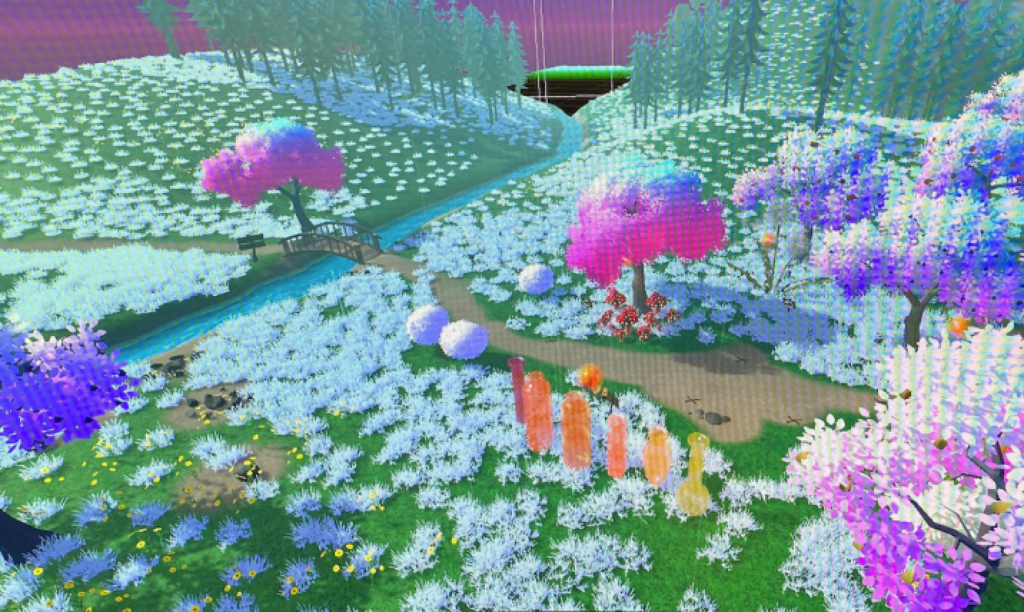
My research area interlinks Virtual Reality design with Mental Health. I believe there are opportunities to challenge the homogenous nature of mindfulness applications by implementing VR technology into platforms that provide experiences curated specifically towards each user’s needs. Furthermore, research connecting VR experiences to biometric data has been proven highly effective; “monitoring…a user’s heart rate, pulse, stress levels, even mood, and then feeding [it] back…[allows for] ultra-immersive, uniquely tailored experiences (Rewind 2021; Rubio-Tamayo, Gértrudix & García 2017). Therefore, I aim for my intervention to take the form of a biometrically- driven, narrative VR experience within the meditation-mindfulness industry.
WHY
Globally, one in six people face at least one mental health issue (Polaris Market Research 2021); in the UK, one in four people report struggling each year (MIND 2020). Mindfulness application downloads have consequently surged; over 2500 new apps launched in the market since 2015 (Singh 2020), the industry giants witnessing over 65 million downloads across 180 countries (Polaris Market Research 2021). Moreover, the VR- based meditation-mindfulness market is forecasted to value at 3.9 billion USD by 2023 (Sawant 2019; Singh 2020). My research is positioned in line with this prediction, however, I believe the one-meditation-fits-all nature of these applications is outdated, and the market needs to shift its focus to human- centered interaction design that takes into account the needs of each end- user. The significance of my research lies in using technology as a tool that brings people a step closer to taking control of their mental health.
HOW
Timescale: 05/2021 – 07/2021
A range of sources are used to aid my project, including but not limited to; the understanding and critical interrogation of published academic journals and scientific research within VR use for mental health, interviews with relevant experts and stakeholders in the field, working with VR design companies to create an initial intervention, as well as collaborating with interdisciplinary creative practitioners who use biometric data for their projects.
Timescale: 07/2021 – 08/2021
Development of my intervention leads to an initial research outcome in the form of a VR game experience which a sample size of n=50 will be used to test, using CSM rental VR headsets and booked rooms. Alternate interventional methods will then be adapted and thus lead to a second round of testing with the same participants.
Timescale: 08/2021 – 09/2021
Final round of testing my intervention commences with my finalised version, this time in a “real- world” scenario with external stakeholders at a location off campus, the results of which are compared and reflected against existing secondary research.
Timescale: 09/2021 – 10/2021
Conclusions from my project are derived and evaluated, further exploration with stakeholders leads to alternate considerations for informed research within the field.
WHAT IF
The measure of success from my research would be indicated in the responses from my targeted intervention participants, alongside a clear progression in the effectiveness of my adapted interventions over the 3 sessions. Prospectively, my research could help create a platform where users gain control over their mental health by creating a routine specifically tailored for their contextual needs, rather than being limited by the options already provided. Following the course, I want to further collaborate with my stakeholders on how my research can be used as a creative tool to help practitioners working within VR design to develop social and experiential platforms.
WORKS CITED
Mind UK. 2021. How common are mental health problems?. [online]
Polaris Market Research. 2021. Mindfulness Meditation Apps Market Size Worth $4,206.1 Million By
2027 | CAGR: 41.01%. [online]
Rewind, 2021. Biometrics Level Up VR And Provide The Next Leap Forward In Human/Computer
Interaction. [online] Medium.
Rubio-Tamayo, J., Gertrudix Barrio, M. and García García, F., 2017. Immersive Environments and
Virtual Reality: Systematic Review and Advances in Communication, Interaction and Simulation.
Multimodal Technologies and Interaction, 1(4), p.21.
Sawant, A., 2019. Virtual Reality in Therapy Market 2019 Global Trends, Size, Segments, Competitors
Strategy, Regional Study and Industry Profit Growth by Forecast to 2023 | ABNewswire. [online]
Singh, P., 2020. Unhooking the Drama: Meditation App Statistics To Know in 2020. [online] Appinventiv.
PROPOSED READING LIST
Gómez, I., Flujas-Contreras, J., Ruiz-Castañeda, D. and Castilla, D., 2018. A Virtual Reality–Based
Psychological Treatment in Long-Term Hospitalization: A Case Study. Clinical Case Studies,
18(1), pp.3-17.
Navarro-Haro, M., López-del-Hoyo, Y., Campos, D., Linehan, M., Hoffman, H., García-Palacios, A.,
Modrego-Alarcón, M., Borao, L. and García-Campayo, J., 2017. Meditation experts try Virtual
Reality Mindfulness: A pilot study evaluation of the feasibility and acceptability of Virtual Reality to
facilitate mindfulness practice in people attending a Mindfulness conference. PLOS ONE, 12(11),
p.e0187777.
Navarro-Haro, M., Modrego-Alarcón, M., Hoffman, H., López-Montoyo, A., Navarro-Gil, M.,
Montero-Marin, J., García-Palacios, A., Borao, L. and García-Campayo, J., 2019. Evaluation of a
Mindfulness-Based Intervention With and Without Virtual Reality Dialectical Behavior Therapy®
Mindfulness Skills Training for the Treatment of Generalized Anxiety Disorder in Primary Care: A
Pilot Study. Frontiers in Psychology, 10.
Oracle. 2021. Can Virtual Experiences Replace Reality? The future role for humans in delivering
customer experience. [online]
Polaris Market Research. 2021. Mindfulness Meditation Apps Market Size Worth $4,206.1 Million By
2027 | CAGR: 41.01%. [online]
Rewind, 2021. Biometrics Level Up VR And Provide The Next Leap Forward In Human/Computer
Interaction. [online] Medium.
Rogers, S., 2021. VR Meditation: The Path To Next-Gen Health & Happiness. [online] Forbes.
Rubio-Tamayo, J., Gertrudix Barrio, M. and García García, F., 2017. Immersive Environments and Virtual
Reality: Systematic Review and Advances in Communication, Interaction and Simulation.
Multimodal Technologies and Interaction, 1(4), p.21.
Sawant, A., 2019. Virtual Reality in Therapy Market 2019 Global Trends, Size, Segments, Competitors
Strategy, Regional Study and Industry Profit Growth by Forecast to 2023 | ABNewswire. [online]
Seabrook, E., Kelly, R., Foley, F., Theiler, S., Thomas, N., Wadley, G. and Nedeljkovic, M., 2020.
Understanding How Virtual Reality Can Support Mindfulness Practice: Mixed Methods Study.
Journal of Medical Internet Research, 22(3), p.e16106.
Singh, P., 2020. Unhooking the Drama: Meditation App Statistics To Know in 2020. [online] Appinventiv.
Tarrant, J., Viczko, J. and Cope, H., 2018. Virtual Reality for Anxiety Reduction Demonstrated by
Quantitative EEG: A Pilot Study. Frontiers in Psychology, 9.
Dear Sam,
I read this article with great interest. I’m a writer currently researching an article for the New York Times on the rise of VR meditation during the pandemic and related benefits for mental wellness. Would you have interest in being interviewed?
I’m hoping to get a better sense of market trends in VR meditation, and you seem very knowledgeable in this area. Would you have thoughts on the factors that have been used to project that mindfulness meditation will be worth $3.9 billion by 2023?
Once I’ve written my draft, I’m happy to share it for your review before submitting it to my editor. Previously, my work has appeared in the Washington Post, where I’m a monthly contributor, the Washington Post Magazine, Wired Magazine and Time Magazine.
It would be great to interview you by Friday, Dec. 17th, if possible. Many thanks for considering the request.
Many thanks for considering the request.
All the best,
Matt
Matt Fuchs
Freelance Writer
p: 615.828.0595 | e: fuchs.87@gmail.com
Hi Matt,
Thanks for reaching out, I’ve popped you over an email.
Best,
Sam