DATA ANALYSIS (SUMMARY):
- Approximately 70% of participants found the experience to have changed their mood in some way.
- Of which, Approximately 83% of participants found the experience to have improved their mood in comparison to the way they felt prior to starting the experience.
- Approximately 30% of participants were unsure if the experience had changed their mood in any way.
- The most associated words with the experience were “curious” (reported by 91.3%), “calm” (reported by 87%), “inspired” (reported by 56.5%) and “relaxed” (reported by 56.5%).
- The least associated words with the experience were “distracted” (reported by 17.4%) and “anxious” (reported by 4.3%).
- On a scale of 1 – (There was not any interaction, I felt like I was just standing and observing) to 10 – (There was too much interaction, I felt like I was immersed in a game), 65.2% of participants agreed that the experience was an acceptable balance of mindfulness and gamification.
- On a scale of 1 – (Not directive at all, I was free to do as I pleased.) to 10 – (Extremely directive, I was guided with clear instructions the whole time), 60.9% of participants agreed that the experience had an appropriate level of direction.
- On a scale of 1 – (Too abstract) to 10 – (Too Realistic), 65.2% of participants agreed that the visuals were balanced between abstract and realism.
- On a scale of 1 – (The sound design did not complement the visuals.) to 10 – (The sound design perfectly complemented the visuals), 60.9% of participants agreed that the positional sound design incorporating supernormal stimulus perfectly complemented the visuals.
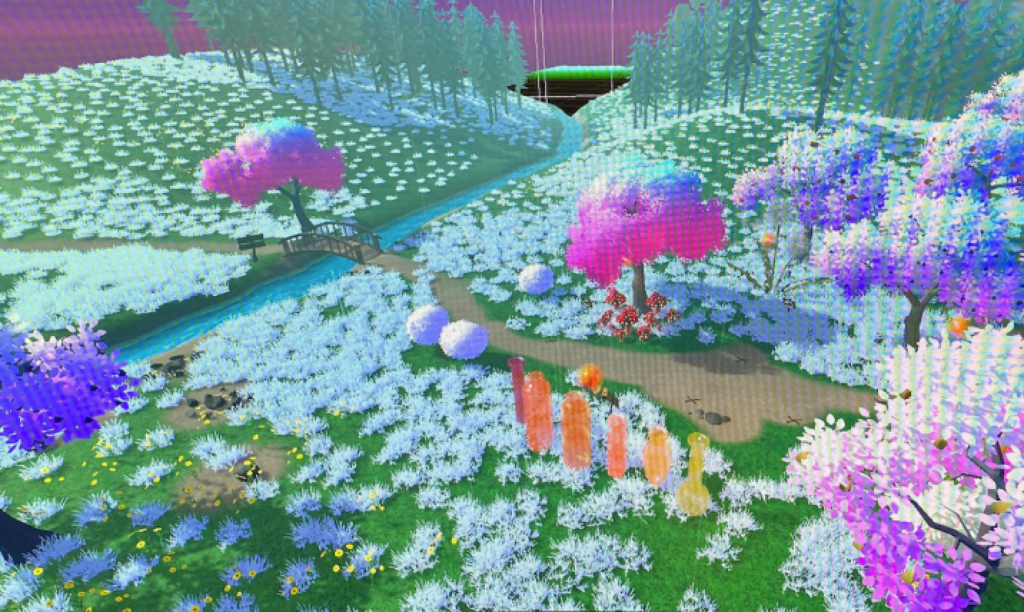
- Of the experience, the world design and rock backgrounds, the pond and the dandelion were most popular, followed by the jellyfish, the rock man the bush and the bottles.
- Of the experience, most participants wanted more (verbal or text) instruction on each exercise, a greater variety of exercises, less distractive visuals, and a greater repetition length of each exercise, followed by quicker loading times.
- Approximately 60.9% of participants were extremely likely to recommend VR- based mindfulness to a friend.
- Approximately 60.9% of participants rated the experience “excellent” (10/10).
Upon an initial analysis of the data from the intervention, I was extremely pleased with the results and the feedback that my project had gotten from both stakeholders who were involved in the process from the very beginning as well as new stakeholders who had no idea what the project would entail before trying the experience.
However, it is also crucial to address that when I first looked at the evidence within the feedback I definitely had confirmation bias and was more inclined to focus on the positive aspects of feedback and attribute the criticisms such as “it was unclear” or “needed more verbal explanation” to age and cultural differences within my stakeholder group, especially in correlation to the survey questions of how interactive and directive the experience was. Albeit, when adopting a more holistic view of the project with my personal tutor I began to look at the results in a different way – which was critical in both moving me beyond my initial bias as well as in finding new ways to improve on my project.
For example, one of the feedback I received from my peer testing group was – “personally I didn’t get much out the breathing exercises, I’m so used to meditating in my own way I struggle when being told to do it another way”. Initially I had been slightly negligent towards this feedback and others that criticised my project for only having breathing exercises, as the participant group had been informed prior to the experience that the main activities would take the shape of breathing exercises. In contrast, when discussing the experience with my expert stakeholder group, the feedback I received was more about using more of the inbuilt VR technology to bring the project up a notch- perhaps by using the range of haptics, or by using positional sound as a narrative driver more than accompaniment. Perhaps it was due to unconscious bias of the feedback of an “expert” group having more importance than my peer group that led me to assess my data in a different light, but I began to understand that both my peer stakeholder group and my expert stakeholder group were trying to say the same thing – which was to use the breadth of technology already inbuilt into VR systems to offer a variety of mindfulness mechanisms that can cater to individual needs. This is something I will definitely be heavily considering moving forward in both my approach as a researcher as well as in my creative development as an artist.