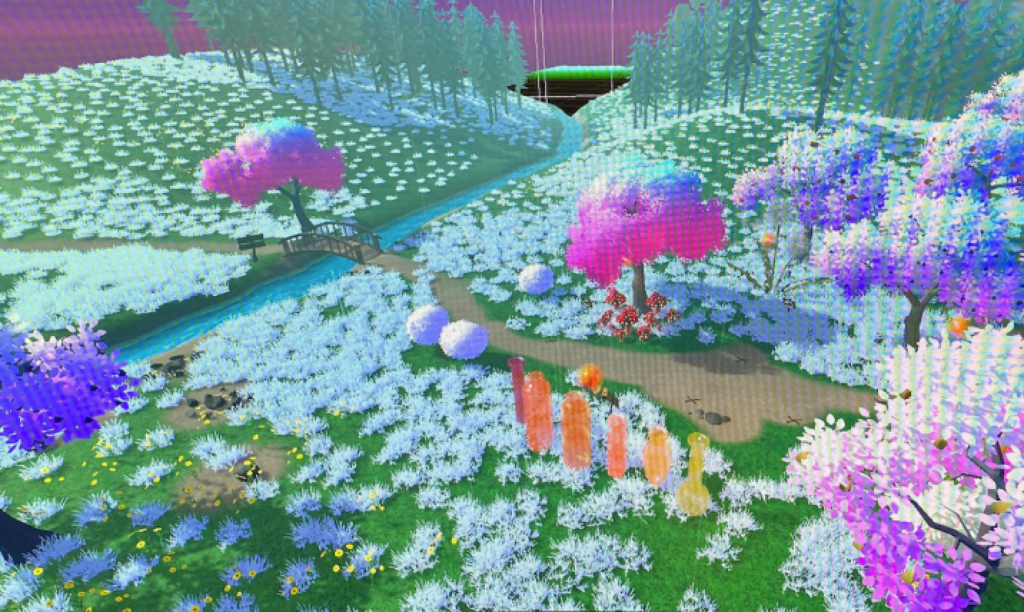
I started August being quite worried (like really worried) about the stage of my project as I am now two weeks behind schedule as a result of Margaret’s technical difficulties with her charger, as well as the general stage of build my project has been in – I feel like on the research side I understood the direction I was heading in and the reasons why my project should work, but not whether it would – something that can only be understood after having been tested.
I took a few days out from the project as I felt like my headspace was occluded with stress more than anything, and decided to come back to my intervention with a fresh, decompressed outlook.
(This break also helped me realise that constantly changing my research question was a completely okay thing to do and was a result of my academic and creative processes evolving, rather than something that was setting me back and making me start at square zero again.)
After having returned to my work, I realised that within the VR industry, creative work is produced collaboratively within a team, rather than just with one researcher and one technician. Hence, I decided to get in touch with two other VR creatives who were extremely kind in offering their creative support and distributing a major task into smaller, more manageable chunks.
The first meeting I had was with Madina, a New-York based VR student at Parsons. In doing our initial image research, Margaret and I used her work as a reference for our VR world.

We then set up a google meeting with Madina, who was extremely knowledgeable about the world build/spacial design aspect of our mindfulness- world, and agreed to help with the initial blueprint and design of the world.
Madina’s involvement in the project not only helps me to focus on a more thorough research justification for the spacial graphics and the world, but also helps Margaret focus on graphically designing the gameobjects/user-interaction side of the world, while Madina focuses on the world/spacial- interaction and design side. It also helps reduce each of their workloads to manageable hours, as I’ve really emphasised to them that this research project is on a collaborative basis and I want to make sure that all parties are happy and comfortable with the time and hours that they invest.
The meeting with Madina brought up a few concerns that Margaret and I were already having with the delivery of the project, namely with the accessibility of it. One of my primary goals of the project was to make VR mindfulness more accessible, albeit that has now changed into more interactive- mindfulness, I still want to make sure people find it accessible. Hence, we decided to deliver the project in a 360- degree “web.gl” format (accessible on a laptop/phone), rather than purely developing it for VR. This would also greatly cut down the time it would take to develop the graphics and spacial design of the world, as web.gl projects have a maximum capacity on the resolution of the project. It would also allow people to have remote access to the experience, which would benefit in external stakeholder feedback, as I would be able to send them a direct link to the project. I would also be able to actually show people the experience as a “teaser”, so they would have an idea of what the project was about.
Although I counted more positives than negatives for converting the project to a web.gl version, initially I was quite doubtful of converting a project made for VR into a web- version, as most of my research on the interaction side has specifically been for VR. However, I was assured by my VR team that 360-degree web.gl projects could be accessed on a VR headset, similar to how youtube 360- degree projects can.
In theory, a lot of the justifications for why VR-interaction methods would translate to a web- version make sense- as a lot of VR- interaction has its roots in gaming, which has traditionally been on a web/phone- screen. Albeit, I will have to conduct further research into whether the interactions are truly comparable and whether they make my study valid.
Perhaps for further research it could also be helpful to create a comparative study for the mindfulness experience done on web versus with a VR headset on- and compare how the experiences differ.
The second VR creative I met with was Radina, who was a UAL graduate in MA Virtual Reality at LCC. Radina currently works within 3D modelling and particle system design, and has a lot of experience within the logistical side of the VR industries.
During our chat, the following pointers/notes came up:
- 360 video is accessible friendly, webgl project instead of vr project make sense.
- real time rendering takes time and too much processing speed, your project should not take more than 30 seconds to load a scene and the polygon count should not go over 300,000.
- the first step is to have a plan of all of the objects and the world/narrative in a one- page brief for the VR creatives to start the build.
- think about how many vertices there will be, will we have movement (yes)
- Radina can help with textures/ resolution of textures/optimisation of textures – for a webgl project often time an enhanced texture can mimic a higher resolution without the technical drawbacks.
- Think about the visual effects and interaction
- Having a duplicate of the VR and the webgl part, 2 sets of objects for VR and webgl, Radina can focus on the webgl and VR logistics and conversion.
- It should take no longer than 3 minutes for people to experience it, both for the actual experience itself as well as the graduate showcase. In Radina’s experience projects lasting longer than 2-3min can miss out on a lot of showcasing/networking opportunities. A 2-3min meditation experience will also make more people more likely to come and try it during the testing rather than something that is longer.
- Research shows that people get used to abstract experiences very quickly- there is a good chance that the world will not alienate them- look into abstract experience theory and research.
My biggest takeaways from the conversation were the time for which my experience would last (initially I was aiming for 10 minutes but I can see how that may be too long), as well as the fact that I should be able to present my project to stakeholders during the final showcase in December and not feel like I have missed out on valuable feedback.
So far, I am quite happy with the developments made, as I now have a team to delegate each aspect of the project:
Sam: research and narrative
Margaret: assets and graphic design of 5 individual interactive components
Madina: spacial design and world build
Radina: logistics and conversion designs between VR and web.gl versions
My next steps are to deliver a 1-2 page brief outlining ALL design and narrative (mindfulness) aspects, alongside an updated research question to my team by Friday, 20th Aug.
Our next meeting as a team will be w/c 30th August, which is when we will establish a timeline for the final build of the world. Our deadline for delivery will be Friday, 1st October.
My project will be tested w/c 4th-8th October, to a sample size of n=25 (aiming for at least 5 people each day). Participants to be confirmed before 27th September.