04/10 Final Exports and VR Review

The last week I spent working with Sion Fletcher, one of my stakeholders from the early intervention and the VR technician at CSM to complete the interactions and sound of the project. I had four sessions with him over the last week, below is a record of the tasks we completed each day as well as what was left over to do the next day.

MONDAY 

  • we made a different project in unity 
    location is assets > scenes folder> 001 
  • The file we are working on is called VR_00 
  • we fixed jelly script  – it was trying trying to switch 3 lights off but there were no lights set up, but it works now
  • however the jellyfish don’t show up?? the prefab disappeared from the video you sent me yesterday too 
  • we have access to HTC vive pro 
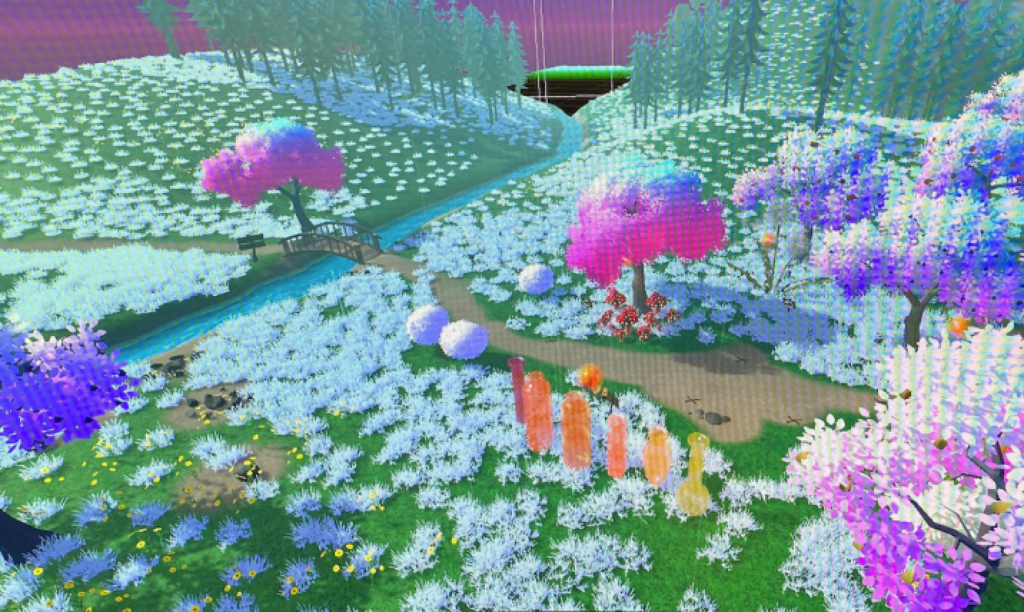
  • we need change colour of blue trees- it’s really jarring in VR 
  • scaling is good

TUESDAY 

  • we changed the settings to XR- openXR- multipass
  • grass overdraw causing blurring on handsets- – if we need to save some performance the grass is the first place to trim down 
  • teleportation is sorted – we need to use the sign posts as a mark/guide on the floor to tell people where to stand, change the box collider to the sign and then have the timer above the sign, use the sign as a guide on where to stand 
  • water in the river by the bridge needs to be fixed – prefab doesn’t show up 
  • dandelions keep coming on at start of play – even without trigger
  • look at the bottles animation for bubble 
  • look at SionJellyAnim for jellyfish script if it keeps acting up and on how to add sound to the animations 
  • we need to sort out the bubble/firework
  • bubble scale is set to 1 1 1 scaling

THURSDAY

  • added sound to elements 1 to 6 
  • i will do a final test on monday 
  • adding copy to signs and next to objects 
  • changing colour scheme and tweaking the environment 
  • export 
  •  jellyfish prefab import
  • we need change colour of blue trees- it’s really jarring in VR
  • water in the river needs to be fixed – doesn’t show up 
  • dandelions keep coming on at start of play – even without trigger
  • have some kind of guide on floor – maybe use the sign posts 
  • change the box collider to the sign and then have the timer above the sign 
  • use the signs as a place to stand 
  • we need to add the text and the copy on the signs 
  • we need to add all the sounds to the animations 
  • still need to add mushroom sound 
  • grass overdraw – if we need to save some performance the grass is the first place to trim down 

MONDAY 

  • tested box colliders with sticks + moved accordingly to optimum position
  • added jellyfish prefab
  • added water in river prefab
  • placed breathing bubble timers – change colour if needed + size
  • placed signs before importing delete the existing signs
  • added pond bubble animation
  • added mushroom sound
  • added jelly sound
  • added pond sound
  • checked all sounds + volume

After having done initial tests on the interactions, we decided it would be ready to test with my stakeholder group for the coming week.

Final Export of the VR world

27/09 Final Design Review Update

This week we completed all the visual designs for the world, and had our final design review. Overall I am pretty happy with the visuals, however there is still quite a bit to be completed regarding the sound and interactions.

Screenshot of final touches on the world design.

LEFT TO DO:

  • ANIMATIONS  
    • glowing bottles
    • glowing stones on rock structure
    • moving spheres (timer) 
    • bubble/fireworks 
    • koi fish in pond 
    • bush glowing 
  • INTERACTIONS 
    • element 1 to 6 trigger collider 
  • SOUND 
    • sounds elements 1 to 6
    • ambient sound
  • LIGHTING 
  • COPY/ TEXT 
    • on signs 
    • next to objects 
  • COLOUR SCHEME AND ENVIRONMENT 
  • BACKGROUND – JISOO ROCK STRUCTURES
  • EXPORT 

Most of this will be worked on over the week, both when I have access to the technician at CSM as well as the headsets to look at scaling and any additional VR formatting that may be needed.

Additional screenshots from the final export:

21/09 First Design Review Update

On Monday we had our first design review of the interactive world, and I honestly could not be more excited with how it’s all coming together.

From starting with the initial intervention:

A time-stamped intervention on youtube.

To creating maps and sketches of the VR environment:

The final agreed design sketch of the VR world.

To the 2D design being finalised:

Final 2D sketch with all the assets – the ends of the sketch meet together to form a 360- degree view.

To actually creating the VR world we could walk through, with assets, animations and textures added:

First design review meeting:
Screenshot from first design review

It felt really rewarding to see the world come to life in terms of the spatial design, and that our work over the last few months had finally paid off.

Notes from first design review:

  • make grass more blue, ground colours generally brighter
  • have a sign next to each gameobject signifying what the exercise is (eg. spine stretch, visualisation, body scan, etc.)
  • add the animations for each object, make sure the colours stand out from the environment
  • change path layout to circular/eg. clearing in the woods
  • keep bridge and water feature – perhaps meeting at a pond- like space where the bubble object can look natural in the space
  • change background mountains to more abstract rock-like shapes – and taller
  • using controllers to teleport the user to objects instead of them having to walk around in the real world

15/09 Major Changes/ Rethinking Project Management

The last week was extremely stressful for me, as both Madina and Margaret had to terminate their involvement in my project, due to professional contracts they had signed with VR companies that prevented any involvement in external projects and/or the creation of any 3D models and designs.

This was especially shocking to me as I have been working with the both of them for quite a few months now, and felt utterly lost without their technical guidance and as though my project was falling apart in its final stages.

Nevertheless, Radina and I decided to create a final- month project calendar to ensure that our project could still be delivered for the testing week of 4th-8th Oct. During this time, I was in charge of all the logistical aspects of VR production while Radina started on the 2D designs.

In about 10 days we had managed to:

  • create a working spreadsheet with all visual assets, animations, copy, sound assets project calendar.
  • set up meetings with 3D creatives who could help create original assets, and got in touch with Jisoo Lim, a 3D designer from Korea who agreed to help our project.
  • finalised the 2D design and agreed on a colour palette.
  • start working on the risk assessments and participant forms.
Screenshot of our meeting with Jisoo where we finalised the 2D image and layout of the experience.
Our project calendar
Our project assets
Sample assets we were testing
List of animations

During this week’s meetings, a few concerns were raised in terms of the formatting of the VR delivery:

  • our project is being developed for the HTC Vive Pro, which is only available at the LCC creative lab – unsure if they will lend us the headsets
  • CSM only rents out the first generation oculus headsets that are compatible with PC, the whole of UAL uses mac- compatibility issue?
  • using teleportation with controllers to move around the scene instead of physically having to walk – allows for health and safety risks to be omitted and for multiple users to be in the same room while socially distancing
  • reaching out to LCC creative lab to sort out the technicalities w/c 27th sept; things like scaling/particle systems/movement within the scene
  • possibly loaning out a headset over the weekend 1st/2nd oct

Timeline/Checklist completion:

27/08/2021 – /27/ 09/2021

  • Deliver a a 1-2 page brief outlining ALL design and narrative (mindfulness) aspects, alongside an updated research question to my team by Friday, 25th Aug. (x)
  • Submit Research Report by 31st Aug. (x)
  • Exposing intervention to external review – sending it to VR experts/stakeholders and taking their feedback on board. (x)
  • Rework updated research question. (x)
  • Next meeting as a team on w/c 30th August to establish timeline to start final build of the world and discuss ownership. (meeting on 4th Sept) (x)
  • 07/09 Unit 2 Presentation (x)
  • Next team meetings on 08/09 (x), 15/09 (x), 22/09 and 29/09.
  • Participants to be confirmed before 27th September, ideally n=25
  • Questionnaire to be created by 27th September.

Project Shortcuts (links)

Condensed Brief:

https://docs.google.com/document/d/1hIfcDk3uOFhLehJKu0yIcsGoD61usB9Bc-GXgvi_1m4/edit?usp=sharing

Padlet Notes/References/Brainstorm Space: (EDIT: the owner of the padlet was my design collaborator who no longer goes to UAL and thus the padlet space has been archived)

(password: mindfulness)

https://artslondon.padlet.org/mpushkar0120191/tptpzvti6oiottf4

Drive Image Research:

https://drive.google.com/drive/folders/1MyVLCp-7xA4RtHS61sqS2tr98la89BWv?usp=sharing

Pinterest Moodboard:

https://www.pinterest.co.uk/margaretpushkar/collaboration-w-sam/

27/08 Impressionist Theory Addition, Updated Research Question, and New Timeline

After doing some research into the field of Neuroaesthetics, I have found impressionist theory to be an extremely valuable addition into my intervention. Neuroaesthetics is an innovative but controversial new area of neuroscience research, which has the potential to help us understand the ways our brain responds to art. With neuroimaging technology, current research has been able to bring scientific objectivity to the study of art, and has already given us a better understanding of many masterpieces. The blurred imagery of Impressionist paintings is oseems to stimulate the brain’s amygdala, for instance. Since the amygdala plays a crucial role in our feelings, that finding might explain why many people find these pieces so moving.

Sources:

https://www.irishtimes.com/news/science/brain-finds-pleasure-in-processing-abstract-art-1.528925

https://impulse.appstate.edu/sites/impulse.appstate.edu/files/McClure%20and%20Siegel_0.pdf

https://www.thecrimson.com/article/2017/11/10/neuroaesthetics-cover/

https://www.the-scientist.com/cover-story/neuroaesthetics-37572

https://books.google.co.uk/books?id=6CX-CwAAQBAJ&pg=PA49&lpg=PA49&dq=An+emerging+discipline+called+neuroaesthetics+is+seeking+to+bring+scientific+objectivity+to+the+study+of+art,+and+has+already+given+us+a+better+understanding+of+many+masterpieces.+The+blurred+imagery+of+Impressionist+paintings+seems+to+stimulate+the+brain%27s+amygdala,+for+instance.+Since+the+amygdala+plays+a+crucial+role+in+our+feelings,+that+finding+might+explain+why+many+people+find+these+pieces+so+moving.+–%3E+The+discipline+of+neuroaesthetics+aims+to+bring+scientific+objectivity+to+the+study+of+art.+Neurological+studies+of+the+brain,+for+example,+demonstrate+the+impact+which+Impressionist+paintings+have+on+our+emotions.&source=bl&ots=V0t1zMcsmz&sig=ACfU3U2oPX_yGXJbV53joh8QgSOcztUSrw&hl=en&sa=X&ved=2ahUKEwjZ2–U6pD0AhWLXsAKHa8jA6cQ6AF6BAgIEAM#v=onepage&q&f=false

Hence the combination of emotion (responses to art stimulated by the amygdala) and memory (abstract environments causing hippocampal cognition to increase) could theoretically be immensely helpful in mindfulness practices, as the user would not only be more emotionally in tune with their mental- wellbeing, but also retain the memory to be in a “mindful” state once the experience is repeated as part of their lifestyle.

I feel as though using impressionist theory is also beneficial as impressionism in fine art is based on the artist’s impression- thus being the “tailored” experience I have been looking for my VR- end users. In terms of positionality, I haven’t seen anything that in the market that focuses specifically on the benefits of impressionist theory for VR- based mindfulness either, and thus this could be a potential space to tap into.

Hence, I have reiterated my research question to:

How can impressionist theory inform naturalistic design choices within abstract artificial environments in Virtual Reality- based mindfulness platforms? 

Below is the new timeline I have decided to readjust my schedule to:

(x) = completed

27/08/2021 – /27/ 09/2021

  • Deliver a a 1-2 page brief outlining ALL design and narrative (mindfulness) aspects, alongside an updated research question to my team by Friday, 25th Aug. (x)
  • Submit Research Report by 31st Aug. (x)
  • Exposing intervention to external review – sending it to VR experts/stakeholders and taking their feedback on board. (x)
  • Rework updated research question. (x)
  • Next meeting as a team on w/c 30th August to establish timeline to start final build of the world and discuss ownership. (meeting on 4th Sept)(x)
  • 07/09 Unit 2 Presentation (x)
  • Next team meetings on 08/09, 15/09, 22/09 and 29/09. (x)
  • Participants to be confirmed before 27th September, ideally n=25(x)
  • Questionnaire to be created by 27th September.(x)

27/09/2021 – /01/ 10/2021

  • ONCE CSM OPENS book rooms and headsets at CSM for testing period of 1 week (5 days), (x) try to get at least 5> headsets and testers booked for each day (ideally n=25> total)
  • Ensuring release forms are ready for participants (if filmed) (x)
  • Team meeting on 28/27/30 Sept for final touches and export on world build. (x)
  • Deadline for final intervention delivery (both VR and WebGL formats) Friday, 1st October. (x)

04/10/2021 – /08/ 10/2021

  • Testing of intervention and recording results(x)
  • Ensure COVID regulations are in place (x)
  • Ensure questionnaire space (x)
  • Exposing intervention to external review again– sending it to VR experts/stakeholders (WebGL version with remote access).(x)
  • Conclusions from my project are derived and evaluated into a report(x)

10/10/2021 – /31/ 10/2021

  • Comparing and reflecting on my research findings in accordance with existing secondary research. (x)
  • Feedback from stakeholders and experts leads to alternate considerations for informed research within the field. (x)
  • What If? part of WWHI addressed(x)

26/08 Research Report

Research Question 

How can familiar naturalistic elements within abstract artificial environments be incorporated into Virtual Reality- based mindfulness platforms to enhance immersion? 

Introduction and Research

Globally, one in six people face at least one mental health issue (Polaris Market Research 2021); in the UK, one in four each year (MIND 2020). Mindfulness application downloads have surged; over 2500 new apps launched since 2015 (Singh 2020) with over 65 million downloads across 180 countries (Polaris Market Research 2021). The VR- based meditation-mindfulness market is forecasted at 3.9 billion USD by 2023 (Sawant 2019; Singh 2020), as VR is mainstreamed as a mindfulness tool (Eysenbach 2020). The significance of my research lies in using technology as a tool that brings people a step closer to taking control of their mental health. 

Studies show that users not only adapt quickly to abstract virtual environments, but that hippocampal cognition (memory) is also enhanced in artificial spaces (Clemenson and Stark 2015, Welch 2002). VR- mindfulness environments set within natural settings are proven to be effective, with research showing decreased systolic blood pressure and heart rate (Yu et al. 2018), and immediate improvements on mood, vitality and restoration (Mattila et al. 2020). Greater benefits are observed in forest settings than urban settings, and virtual forests were found as more or equally restorative as physical forests during data comparison (Matilla et al. 2020)- a plausible reason for most VR- mindfulness experiences being set in familiar forest settings. However, contrasting research shows that the depiction of naturally existing characters (such as animals) at realism levels used in current virtual worlds elicits alienating reactions similar to the predictions of the uncanny valley for humanlike characters, leading to the consensus that natural characters should be given a stylised appearance in order to keep the audience engaged  (Schwind et. al 2017, Sparks 2019). Apart from VR design, research was also conducted within traditional and contemporary mindfulness practices, specifically breathing techniques and visualisations effective for relieving social anxiety, based on Fleming and Kocovski’s method for the incorporation of mindfulness into cognitive behavioural therapy (Ackerman 2020, Fleming and Kocovski 2013). 

When conducting a SWOT analysis on the globally most downloaded VR- mindfulness apps such as Oculus Guided Meditation VR and Tripp VR, I found a clear gap in the existing market- these experiences were either completely trying to replicate a natural environment (either artificially or using a 360 camera and then translating to a VR- format), or were completely abstract environments with stylised features. Therefore, my research question is positioned to find a middle- ground format for VR- mindfulness as an alternative for an audience that is more visual, by hybridising the theoretical benefits of familiar naturalistic elements within an stylised artificial environment, through the use of visuals and sound to enhance the user’s immersion within the experience. 

Methodology

A range of primary and secondary sources have been critically interrogated for my research, including but not limited to; published academic journals and scientific research within the VR and mindfulness-meditation industries, interviews with relevant experts and stakeholders in the field of VR and interaction design, working collaboratively VR creatives to create an initial intervention, as well as testing the intervention with stakeholders within my network. Moreover, extensive research has been conducted into mindfulness exercises pertaining to the breath and body, as well as a SWOT analysis of the most popular platforms (VR and mobile) in the current market and the variety of exercises offered. 

Intervention

A 3- minute VR- based mindfulness experience in which users interact with 6 ‘gameobjects’ resembling familiar elements in nature, each accompanied by a different breathing exercise. The timed interactions are set in an abstract world, with large rock-like figures in the distance, and a clear distinction that the ground below is grass- like, and that the space above resembles a sky, despite colours and textures being completely different. The end- user only interacts with the gameobjects around them. Although initially wanting users to interact with the complete space to feel a sense of autonomy and agency within the world instead of being directed, discussions with a VR expert led to reconsiderations pertaining to the information hierarchy of the experience and the potentially negative implications that too much stimulus could have on the user’s attention (Hines 2019). The spatial design is animated and visibly artificial, and each gameobject is accompanied by positional naturalistic sound. The positional sound will be used as a supernormal stimulus in order to keep the user’s attention on specific exercises (Barrett 2015) and in turn ensure that the visuals of the space are used as a visualisation tool, rather than seen as a distraction.

Audience

Although my project is accessible to viewers of any age, my target demographic is 18-35 year olds who already have either some or frequent experience with traditional mindfulness exercises, including the use of mobile meditation apps. 

To date, the intervention has been tested on creative professionals between 18-50 due to several factors. In studies conducted by Limina Immersive, the demographic demonstrating the biggest interest in purchasing a VR headset in the UK were 18- 24 year olds, and the age group found most likely to own a headset was 35-44 (Allen 2021). Despite an even age distribution between downloads of popular meditation applications (Curry 2021), studies show that young adults in the UK (18-30) are the group most aware of daily mindfulness practices and have the highest engagement rates of regular practice (Simonsson et al 2020).  

My audience consisted of coursemates, creative professionals in my network, and external experts within the VR, Film and Television industries. Initially, I wanted to test the intervention with experts within the mindfulness industries, however after a few attempts it was clear that VR had not been adopted as a tool 

within the mindfulness industries in the same way that mindfulness was an area of exploration within VR. With that acknowledgement, my stakeholder pool consisted of VR creatives and producers who had worked on mindfulness projects, both as an independent practice as well as externally for clients such as Headspace and Calm. 

Conclusion

Throughout my research I have discovered strengths and areas of improvement, not only in the project but as well as in myself as a learner. For example, I was surprised when stakeholders were interested in the intervention during discussions and seemed eager to try it, which consequently made me confident in pitching to external collaborators and being more open with my goals. I have also learnt the value of interdisciplinary collaboration by breaking free of the mentality of feeling alone in my research. Getting as many people involved in this project has generated a diverse range of insight and invaluable feedback, as well as given me reassurance of creative support within my network. Working in a team also led me to develop new skills and those in existence, such as project management, accurate communication, and time and people management. Areas for reconsideration in my project would involve coming to terms with the feasibility of the project- I had greatly underestimated how important it was to have a specific research area and took too long to condense my research question and specify my intentions, due to which, I had limited time to focus on sound- design in my intervention, an arguably crucial part of any VR experience. Moreover, I did not test or consider the accessibility requirements of non- english speakers, or physically-disabled and neurodivergent end- users for my project, which are important areas to focus on in future. 

Bibliography 

Ackerman, C., 2020. 22 Mindfulness Exercises, Techniques & Activities For Adults (+ PDF’s). [online] 

Allen, C., 2021. Understanding The VR Market. [online] Immersivepromotion.com. 

Barrett, D., 2015. Supernormal Stimuli. Encyclopedia of Evolutionary Psychological Science, pp.1-2.

Clemenson, G. and Stark, C., 2015. Virtual Environmental Enrichment through Video Games Improves 

Hippocampal-Associated Memory. Journal of Neuroscience, 35(49), pp.16116-16125.

Curry, D., 2021. Headspace Revenue and Usage Statistics (2021). [online] Business of Apps. 

Eysenbach, G., Kelly, R., Foley, F., Theiler, S., Thomas, N., Wadley, G. and Nedeljkovic, M., 2020. 

Understanding How Virtual Reality Can Support Mindfulness Practice: Mixed Methods Study. 

Journal of Medical Internet Research, 22(3), p.e16106.

Fleming, J., Kocovski, N., Hawley, L., Huta, V. and Antony, M., 2013. Mindfulness and acceptance-based 

group therapy versus traditional cognitive behavioral group therapy for social anxiety disorder: A randomized controlled trial. Behaviour Research and Therapy, 51(12), pp.889-898.

Hines, R., 2019. VR design principles – Immersive Studios. [online] Immersive Studios.

Mattila, O., Korhonen, A., Pöyry, E., Hauru, K., Holopainen, J. and Parvinen, P., 2020. Restoration in a 

virtual reality forest environment. Computers in Human Behavior, 107, p.106295.

Mind UK. 2021. How common are mental health problems?. [online] 

Polaris Market Research. 2021. Mindfulness Meditation Apps Market Size Worth $4,206.1 Million By 

2027 | CAGR: 41.01%. [online] 

Sawant, A., 2019. Virtual Reality in Therapy Market 2019 Global Trends, Size, Segments, Competitors  

Strategy, Regional Study and Industry Profit Growth by Forecast to 2023 | ABNewswire. [online] 

Schwind, V., Leicht, K., Jäger, S., Wolf, K. and Henze, N., 2017. Is there an uncanny valley of virtual 

animals? A quantitative and qualitative investigation. International Journal of Human-Computer 

Studies, 111, pp.49-61.

Simonsson, O., Fisher, S. and Martin, M., 2020. Awareness and Experience of Mindfulness in Britain. 

Sociological Research Online, p.136078042098076.

Singh, P., 2020. Unhooking the Drama: Meditation App Statistics To Know in 2020. [online] Appinventiv.

Sparks, M., 2019. Metafocus: Avoiding the Uncanny Valley in VR & Serious Games. [online] Learning 

Solutions Magazine.

Welch, R., 2002. Handbook of Virtual Environments. 1st ed. CRC Press.

Yu, C., Lee, H. and Luo, X., 2018. The effect of virtual reality forest and urban environments on 

physiological and psychological responses. Urban Forestry & Urban Greening, 35, pp.106-114.
20/08 Research Report Tutorial Feedback

In discussing my research report, I noticed several areas of growth over the summer period that I had not thought of before, both in terms 0f the maturity of my project from the proposal period as well as in my own skills as a learner.

Firstly, I have become less afraid to rethink and redevelop my research question when need be – something I saw as an act of failure before. Even now, when I have my final research question ready to be tested, the tutorials have brought up considerations/ alternate versions of my question that improve the quality of my research. My current question of “How can the incorporation of familiar naturalistic elements within abstract artificial environments be used within Virtual Reality- based mindfulness platforms to enhance immersion?” is perceived as a bit of a leading question to my tutorial group – as though I have already answered it within the question.

Hence, I will need to work on restructuring the question into one that facilitates open- ended research.

Redrafts (Work in progress):

  • How can virtual reality based mindfulness experiences increase immersion through access?
  • How can VR based mindfulness platforms enhance immersion?
  • How can stylised naturalistic elements enhance immersion within virtual reality-based mindfulness platforms?

Second, I have also made more of an effort to answer the “why” of my intervention, in terms of the need for the project.

  • I want users to have autonomy and agency in mindfulness than an experience that is completely directive (gap in market)
  • I want to use VR mindfulness as a viable alternative to traditional mindfulness – an alternative for users who are more visual and need an immersive experience to feel like it’s making a difference
  • I want to create an experience that lets users have capacity and access to alternate mindfulness tools that exist outside of what is already available. (relating to my research proposal, I want to challenge the “one size fits all” market by tapping into an area that is beginning to be adopted by the mainstream mindfulness industries).
Initial birds- eye spatial map sketch

Due to the collaborative nature of my project, I have also become better at project management, time management, and setting deadlines for each aspect of my intervention – something I had not expected in the earlier stages of the project.

During our tutorial, it was discussed that my next steps would be to work on distributing the ownership of my project due to its collaborative nature, as well as on the questionnaire for participants following the experience.

Questionnaire notes:

Examples of questionnaires following TRIP mindfulness VR experience

18/08 Expert Stakeholder Feedback – Nexus Studios

This week I met with Colin, an executive producer at Nexus studios – who have created VR assets for clients like Google and Headspace. After having explained my project to him, the following feedback was given:

  • VR has a higher creative burden to carry in comparison to traditional mindfulness art experiences – Marina Abramovich techniques will not work in VR for this particular research question as it is too distractive.
  • Mindfulness helps screen out the real environment, so does VR.
  • It is important to rely on sound design for my project, namely positional sound. Using binaural microphones (mics placed where your ears are for positional data and hearing it back how you would hear the space) helps people to be immersed in the content.
  • Visuals tell you what to think, sound tells you what to feel, sound is a key indicator – think about spatial audio.
  • Idea of supernormal stimuli – taking things that exist in that natural world and exaggerating them for stimuli – an easy example is how flavoured candy is shaped and coloured to look like real fruit, etc.
  • Thinking about using the sound of streams, wind through grass as ASMR triggers that can be exaggerated within the hypothetical space of the VR world.  
  • Binaural sound gets a better response than stereo sound because your brain is picking up the sound as an environment.
  • Unity has tools that make binaural sound quite easy, you can place sound objects in space.
  • Using pheromones and smell as an example of sensory excitation, your sense of smell is 5x higher when your head is moving – sound can similarly provide cues that put people into an environment.
  • Getting people to not focus on the novelty is difficult, you don’t want people to focus on the game state rather than the mindfulness state – incorporate a mindfulness activity with each asset to make it relevant.
  • Look into marshmallow laser feast – they did an exhibition on visualising the breath that can be relevant to my project.  
  • For visuals, go into a very simplistic space with that is more abstract than literal; it can help create an environment that is less distracting and more enabling.
  • Neon/tron aesthetic – simple grid lines.
  • Focus on breath rather than transformation, for example use objects on the ground that can raise into the sky as a breathing tool.
  • Think about the information hierarchy of the experience – visuals, sound, mindfulness elements.
  • Filling the phobia – filling out your entire field of view blocks everything else out and helps immersion. – useful for the webgl version.

My biggest takeaways from the meeting were the importance of sound design and the information hierarchy in my project, as these were things that I had not necessarily considered before.

Moving forward, I think I will have to come up with a way to allow simplistic sound design into the experience for it to become even more immersive and effective.

Continuous Log – Research Question Development

(Keeping a log of my research question development)

May/June Proposal Q – How can Virtual Reality design in combination with biometric data be implemented into mindfulness- based experiences to provide tailored narratives unique to the user?

June/July Research Q-How can artificial environments be implemented into mindfulness- based Virtual Reality experiences in order to provide tailored narratives that are unique to each user?

August Research Q- How can the incorporation of familiar naturalistic elements within abstract artificial environments be used within Virtual Reality- based mindfulness platforms to enhance immersion? 

August/September Research Q- How can impressionist theory inform naturalistic design choices within abstract artificial environments in Virtual Reality- based mindfulness platforms to enhance immersion? 

October Research Q- How can impressionist theory inform naturalistic design choices within stylised artificial environments in Virtual Reality – based mindfulness platforms?

November Research Q- How can impressionist theory inform naturalistic design within stylised Virtual Reality – based mindfulness environments?