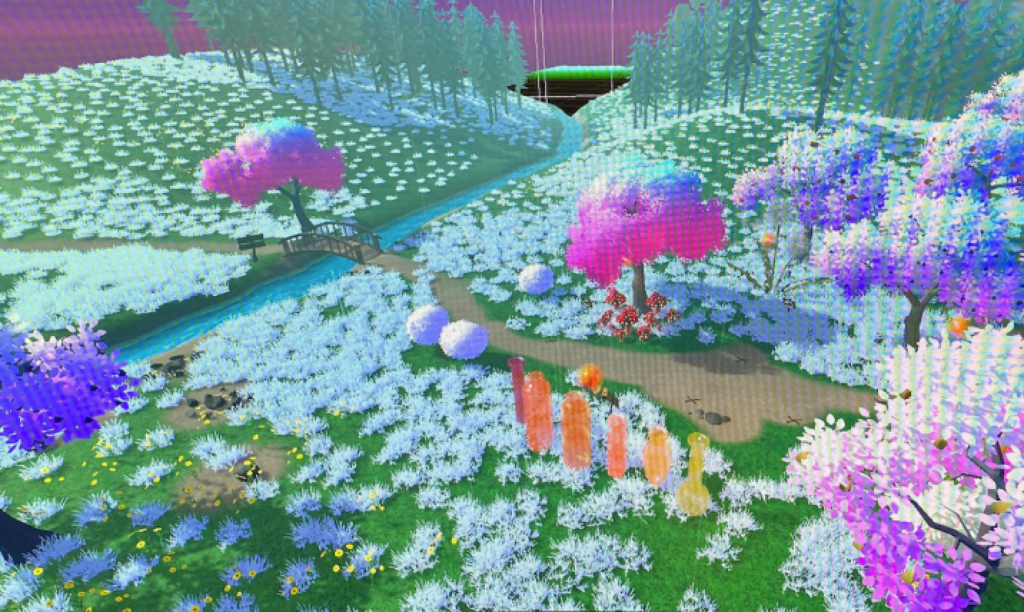
In feedback that I have received from both my personal tutor as well as my stakeholders, it would appear that my research question seems legible (and understandable) when written down, but when verbally communicated it seems too wordy and takes a while to digest. Hence, as a final attempt to reiterate the research question, I broke the current question down into segments in order to highlight and signify the importance of each specific technical terminology.
Current Question: How can impressionist theory inform naturalistic design choices within stylised artificial environments in Virtual Reality – based mindfulness platforms?
Glossary:
- The “How Can” format is one that has been strongly encouraged by our course tutors (initially I had the question in a “to what extent” format but was advised to revise it).
- “Impressionist theory” refers to late 19th century art movement interested in capturing the fleeting qualities of light, color, and atmosphere as well as the emerging psychological principles concerning human consciousness, widely associated with the paintings of Monet, Manet, Renoir, Cezanne, and Degas. Impressionism represents the growing belief that the perception of reality that is mediated by personal emotion and memory. Taken as a whole, Impressionism argues that we don’t really see the natural or “real” world objectively because everything that we perceive is filtered through our minds, and our minds are filled with unique and personal memories and emotions, so each of our minds perceives the world differently. The movement grows directly out of the profound influence of Freud’s theory that we’re constantly reminded that our emotional and subconscious “clouds” our perceptions, and this is rooted in Rousseau’s “I felt before I thought.” Impressionism attempts to capture/represent psychological perception of experience; experience as perceived by the mind, not just the eye or an objective observer. An emerging discipline called neuroaesthetics is seeking to bring scientific objectivity to the study of art, and has already given us a better understanding of many masterpieces. The blurred imagery of Impressionist paintings seems to stimulate the brain’s amygdala, for instance. Since the amygdala plays a crucial role in our feelings, that finding might explain why many people find these pieces so moving. (Source: https://www.webpages.uidaho.edu/engl_258/Lecture%20Notes/impressionism.htm)
- “Naturalistic Design Choices” refers to fine art theory, where “naturalism” describes a true-to-life style which involves the representation or depiction of nature (including people) with the least possible distortion or interpretation. There is a quasi-photographic quality to the best naturalistic paintings: a quality which requires a minimum amount of visual detail. (Source: http://www.visual-arts-cork.com/history-of-art/naturalism.htm). VR- mindfulness environments set within natural settings are proven to be extremely effective, with research showing decreased systolic blood pressure and heart rate (Yu et al. 2018), and immediate improvements on mood, vitality and restoration (Mattila et al. 2020). Greater benefits are observed in forest settings than urban settings, and virtual forests were found as more or equally restorative as physical forests during data comparison (Matilla et al. 2020)- a plausible reason for most VR- mindfulness experiences being set in familiar forest settings.
- “Stylised Artifical Environments” refers to the creation of an artificial environment to move beyond the creation of mental images to a level that allows us to see things that do not exist in the real world or to share this view with others. In VR, the use of computer modeling and simulation that enables a person to interact with an artificial three-dimensional (3-D) visual or other sensory environment (Source: Merriam Webster). Current research shows that the depiction of naturally existing characters (such as animals) at realism levels used in current virtual worlds elicits alienating reactions similar to the predictions of Freud’s uncanny valley for humanlike characters, leading to the consensus that natural characters should be given a stylised appearance in order to keep the audience engaged (Schwind et. al 2017, Sparks 2019).
- “Virtual Reality” is defined as the computer-generated simulation of a three-dimensional image or environment that can be interacted with in a seemingly real or physical way by a person using special electronic equipment, such as a helmet with a screen inside or gloves fitted with sensors. (Source: Oxford Dictionary).
- “Mindfulness- platform” is a digital (in my case, VR) platform that encourages users towards a mental state achieved by focusing one’s awareness on the present moment, while calmly acknowledging and accepting one’s feelings, thoughts, and bodily sensations, used as a therapeutic technique (Source: Oxford Dictionary).
After deconstructing my question: I used the below checklist to reevaluate the question in its final stage.
- Simplify – the simpler the question, usually the more powerful.
I feel like I’ve simplified the question as much as possible, though I could cut a few words down that give the question the same meaning.
Getting rid of the words “choices” (as that is already implied) and “artificial environments” as that is already a bi-product of having a VR environment.
- Explicate – what hidden assumptions lie buried in this question?
The hidden assumptions that lie in the question is that it could be leading, as though I’ve already decided that impressionist theory has a positive effect on design within VR. This is something I have to careful to explain when engaging with stakeholders.
- Edit – are there any irrelevant ideas attached to this project – like barnacles.
Perhaps in the idea of naturalistic design – it could limit my research to only natural or naturally- inspired environments.
- Disentangle – is there another question hidden inside this question? Is there a hidden agenda? Expose it to scrutiny.
A few – Is there really such thing as naturalistic design if the environment is stylised? To what extent can design be naturalistic if the platform is stylised? How would a user react to a VR- mindfulness platform that was completely stylised and did not incorporate naturalistic design?
- Sharpen – could this question be refined and redefined, to make it sharper and more purposeful?
Reiterated Question: How can impressionist theory inform naturalistic design within stylised Virtual Reality – based mindfulness environments?