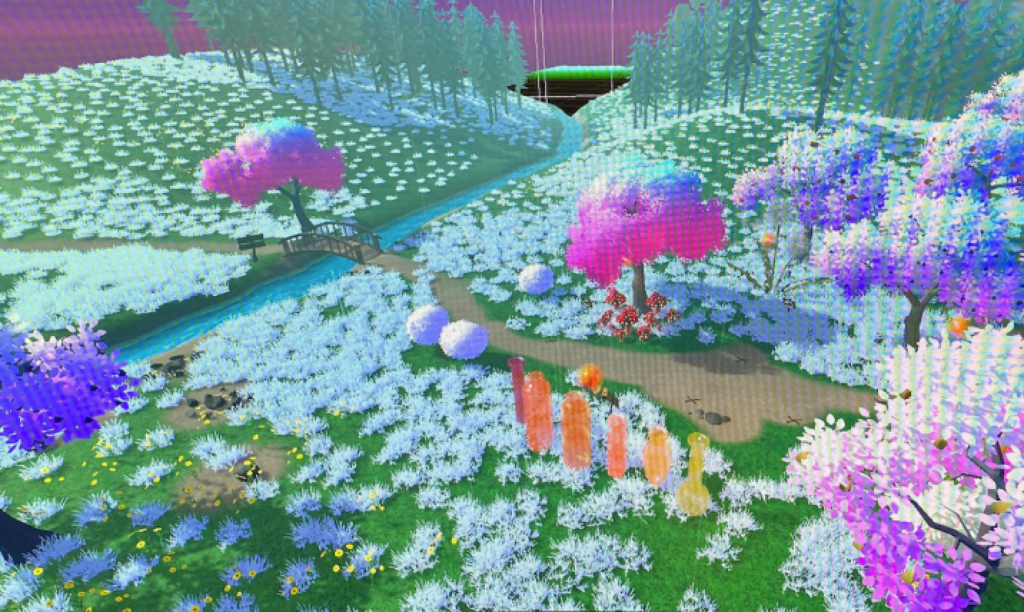
This week I worked on more image research and consolidating the game world into an interactive space. One of the major questions I have been reiterating throughout the process has been the extent to which I want the VR world to be interactive- where in the spectrum between the end- user standing there and just observing the world to the end- user interacting with a playable game do I want my experience to be?
We also decided that instead of being sound directed, it would make more sense for the user to have the freedom of exploring the world, being able to explore their own space rather than being told what to do. In that way, it would make developing the experience a lot easier as events can happen concurrently without the user feeling like they’re missing out on a particular element.

(Screenshot of meeting breaking down the interactive space into “blocks” where certain elements will be present.)
A few more questions arose in our meeting which are integral to answer moving forward:
- Where in the interactive scale do I want my experience to be? No interaction vs. full interaction
- How many elements should I incorporate into my experience? (5-8 seems to be the most comfortable answer)
- Should all the elements be interactive?
- What kind of mindfulness elements should be incorporated into each “activity”?
Another main talking point was the visualisation of breath in our experience. Upon doing research I found that one of the most common breathing techniques in meditation involved the visualisation of the breath, most commonly as breathing in a certain colour and then breathing out a different colour.
Sources:
Micallef, C., 2018. Effects of Deep Breathing, Visualisation and Vocalisation on Levels of Stress and Anxiety
https://www.mondaycampaigns.org/destress-monday/deep-breathing-visualization
https://www.sharecare.com/health/breathing-exercise-techniques/visualized-breathing
In our experience, I wanted to incorporate an actual visualisation of the breath after a breathing activity. Our initial considerations were warm, gold flecks of breath in and out, resembling Dandelion spores:
Initially we had wanted the “gold dust” to be triggered by the sound of the end- user exhaling, but then decided it would be much easier to do it with the timing of the exercise (eg. having it correspond with a physical countdown that the user could see)
Apart from the meeting, I also got in touch with Nexus studios, who do VR- based experiential marketing, in order to understand how a VR schedule worked (similar to a shooting schedule in film).
They also forwarded me to the BBC VR academy where I found more questions to keep in mind for the experience: https://www.bbc.com/academy-guides/virtual-reality-production-where-do-i-start
- Be aware that when VR is designed incorrectly it can cause motion sickness in some audiences
- Consider the role of the user in your VR experience. Are they a character in the story or are they an invisible observer?
- Use dialogue, music and sound effects to steer users’ gaze within the 360 environment. Spatial audio is important to immerse users and guide them
- Remember that each platform will have its own technical specifications to meet