Research Question
How can familiar naturalistic elements within abstract artificial environments be incorporated into Virtual Reality- based mindfulness platforms to enhance immersion?
Introduction and Research
Globally, one in six people face at least one mental health issue (Polaris Market Research 2021); in the UK, one in four each year (MIND 2020). Mindfulness application downloads have surged; over 2500 new apps launched since 2015 (Singh 2020) with over 65 million downloads across 180 countries (Polaris Market Research 2021). The VR- based meditation-mindfulness market is forecasted at 3.9 billion USD by 2023 (Sawant 2019; Singh 2020), as VR is mainstreamed as a mindfulness tool (Eysenbach 2020). The significance of my research lies in using technology as a tool that brings people a step closer to taking control of their mental health.
Studies show that users not only adapt quickly to abstract virtual environments, but that hippocampal cognition (memory) is also enhanced in artificial spaces (Clemenson and Stark 2015, Welch 2002). VR- mindfulness environments set within natural settings are proven to be effective, with research showing decreased systolic blood pressure and heart rate (Yu et al. 2018), and immediate improvements on mood, vitality and restoration (Mattila et al. 2020). Greater benefits are observed in forest settings than urban settings, and virtual forests were found as more or equally restorative as physical forests during data comparison (Matilla et al. 2020)- a plausible reason for most VR- mindfulness experiences being set in familiar forest settings. However, contrasting research shows that the depiction of naturally existing characters (such as animals) at realism levels used in current virtual worlds elicits alienating reactions similar to the predictions of the uncanny valley for humanlike characters, leading to the consensus that natural characters should be given a stylised appearance in order to keep the audience engaged (Schwind et. al 2017, Sparks 2019). Apart from VR design, research was also conducted within traditional and contemporary mindfulness practices, specifically breathing techniques and visualisations effective for relieving social anxiety, based on Fleming and Kocovski’s method for the incorporation of mindfulness into cognitive behavioural therapy (Ackerman 2020, Fleming and Kocovski 2013).
When conducting a SWOT analysis on the globally most downloaded VR- mindfulness apps such as Oculus Guided Meditation VR and Tripp VR, I found a clear gap in the existing market- these experiences were either completely trying to replicate a natural environment (either artificially or using a 360 camera and then translating to a VR- format), or were completely abstract environments with stylised features. Therefore, my research question is positioned to find a middle- ground format for VR- mindfulness as an alternative for an audience that is more visual, by hybridising the theoretical benefits of familiar naturalistic elements within an stylised artificial environment, through the use of visuals and sound to enhance the user’s immersion within the experience.
Methodology
A range of primary and secondary sources have been critically interrogated for my research, including but not limited to; published academic journals and scientific research within the VR and mindfulness-meditation industries, interviews with relevant experts and stakeholders in the field of VR and interaction design, working collaboratively VR creatives to create an initial intervention, as well as testing the intervention with stakeholders within my network. Moreover, extensive research has been conducted into mindfulness exercises pertaining to the breath and body, as well as a SWOT analysis of the most popular platforms (VR and mobile) in the current market and the variety of exercises offered.
Intervention
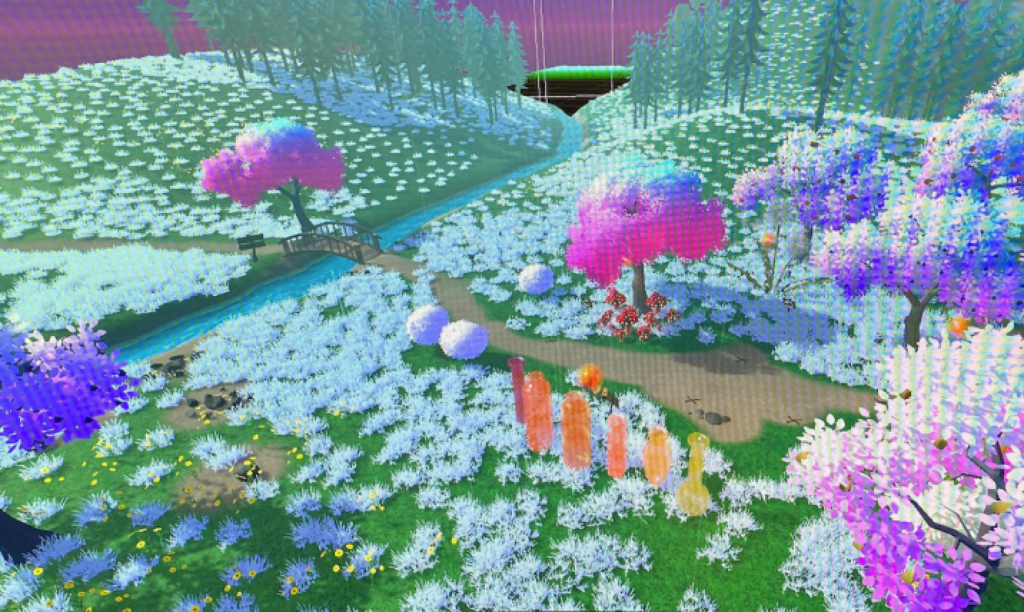
A 3- minute VR- based mindfulness experience in which users interact with 6 ‘gameobjects’ resembling familiar elements in nature, each accompanied by a different breathing exercise. The timed interactions are set in an abstract world, with large rock-like figures in the distance, and a clear distinction that the ground below is grass- like, and that the space above resembles a sky, despite colours and textures being completely different. The end- user only interacts with the gameobjects around them. Although initially wanting users to interact with the complete space to feel a sense of autonomy and agency within the world instead of being directed, discussions with a VR expert led to reconsiderations pertaining to the information hierarchy of the experience and the potentially negative implications that too much stimulus could have on the user’s attention (Hines 2019). The spatial design is animated and visibly artificial, and each gameobject is accompanied by positional naturalistic sound. The positional sound will be used as a supernormal stimulus in order to keep the user’s attention on specific exercises (Barrett 2015) and in turn ensure that the visuals of the space are used as a visualisation tool, rather than seen as a distraction.
Audience
Although my project is accessible to viewers of any age, my target demographic is 18-35 year olds who already have either some or frequent experience with traditional mindfulness exercises, including the use of mobile meditation apps.
To date, the intervention has been tested on creative professionals between 18-50 due to several factors. In studies conducted by Limina Immersive, the demographic demonstrating the biggest interest in purchasing a VR headset in the UK were 18- 24 year olds, and the age group found most likely to own a headset was 35-44 (Allen 2021). Despite an even age distribution between downloads of popular meditation applications (Curry 2021), studies show that young adults in the UK (18-30) are the group most aware of daily mindfulness practices and have the highest engagement rates of regular practice (Simonsson et al 2020).
My audience consisted of coursemates, creative professionals in my network, and external experts within the VR, Film and Television industries. Initially, I wanted to test the intervention with experts within the mindfulness industries, however after a few attempts it was clear that VR had not been adopted as a tool
within the mindfulness industries in the same way that mindfulness was an area of exploration within VR. With that acknowledgement, my stakeholder pool consisted of VR creatives and producers who had worked on mindfulness projects, both as an independent practice as well as externally for clients such as Headspace and Calm.
Conclusion
Throughout my research I have discovered strengths and areas of improvement, not only in the project but as well as in myself as a learner. For example, I was surprised when stakeholders were interested in the intervention during discussions and seemed eager to try it, which consequently made me confident in pitching to external collaborators and being more open with my goals. I have also learnt the value of interdisciplinary collaboration by breaking free of the mentality of feeling alone in my research. Getting as many people involved in this project has generated a diverse range of insight and invaluable feedback, as well as given me reassurance of creative support within my network. Working in a team also led me to develop new skills and those in existence, such as project management, accurate communication, and time and people management. Areas for reconsideration in my project would involve coming to terms with the feasibility of the project- I had greatly underestimated how important it was to have a specific research area and took too long to condense my research question and specify my intentions, due to which, I had limited time to focus on sound- design in my intervention, an arguably crucial part of any VR experience. Moreover, I did not test or consider the accessibility requirements of non- english speakers, or physically-disabled and neurodivergent end- users for my project, which are important areas to focus on in future.
Bibliography
Ackerman, C., 2020. 22 Mindfulness Exercises, Techniques & Activities For Adults (+ PDF’s). [online]
Allen, C., 2021. Understanding The VR Market. [online] Immersivepromotion.com.
Barrett, D., 2015. Supernormal Stimuli. Encyclopedia of Evolutionary Psychological Science, pp.1-2.
Clemenson, G. and Stark, C., 2015. Virtual Environmental Enrichment through Video Games Improves
Hippocampal-Associated Memory. Journal of Neuroscience, 35(49), pp.16116-16125.
Curry, D., 2021. Headspace Revenue and Usage Statistics (2021). [online] Business of Apps.
Eysenbach, G., Kelly, R., Foley, F., Theiler, S., Thomas, N., Wadley, G. and Nedeljkovic, M., 2020.
Understanding How Virtual Reality Can Support Mindfulness Practice: Mixed Methods Study.
Journal of Medical Internet Research, 22(3), p.e16106.
Fleming, J., Kocovski, N., Hawley, L., Huta, V. and Antony, M., 2013. Mindfulness and acceptance-based
group therapy versus traditional cognitive behavioral group therapy for social anxiety disorder: A randomized controlled trial. Behaviour Research and Therapy, 51(12), pp.889-898.
Hines, R., 2019. VR design principles – Immersive Studios. [online] Immersive Studios.
Mattila, O., Korhonen, A., Pöyry, E., Hauru, K., Holopainen, J. and Parvinen, P., 2020. Restoration in a
virtual reality forest environment. Computers in Human Behavior, 107, p.106295.
Mind UK. 2021. How common are mental health problems?. [online]
Polaris Market Research. 2021. Mindfulness Meditation Apps Market Size Worth $4,206.1 Million By
2027 | CAGR: 41.01%. [online]
Sawant, A., 2019. Virtual Reality in Therapy Market 2019 Global Trends, Size, Segments, Competitors
Strategy, Regional Study and Industry Profit Growth by Forecast to 2023 | ABNewswire. [online]
Schwind, V., Leicht, K., Jäger, S., Wolf, K. and Henze, N., 2017. Is there an uncanny valley of virtual
animals? A quantitative and qualitative investigation. International Journal of Human-Computer
Studies, 111, pp.49-61.
Simonsson, O., Fisher, S. and Martin, M., 2020. Awareness and Experience of Mindfulness in Britain.
Sociological Research Online, p.136078042098076.
Singh, P., 2020. Unhooking the Drama: Meditation App Statistics To Know in 2020. [online] Appinventiv.
Sparks, M., 2019. Metafocus: Avoiding the Uncanny Valley in VR & Serious Games. [online] Learning
Solutions Magazine.
Welch, R., 2002. Handbook of Virtual Environments. 1st ed. CRC Press.
Yu, C., Lee, H. and Luo, X., 2018. The effect of virtual reality forest and urban environments on
physiological and psychological responses. Urban Forestry & Urban Greening, 35, pp.106-114.