16/08 Research Update, New Stakeholders and Initial Project Management

I started August being quite worried (like really worried) about the stage of my project as I am now two weeks behind schedule as a result of Margaret’s technical difficulties with her charger, as well as the general stage of build my project has been in – I feel like on the research side I understood the direction I was heading in and the reasons why my project should work, but not whether it would – something that can only be understood after having been tested.

I took a few days out from the project as I felt like my headspace was occluded with stress more than anything, and decided to come back to my intervention with a fresh, decompressed outlook.

(This break also helped me realise that constantly changing my research question was a completely okay thing to do and was a result of my academic and creative processes evolving, rather than something that was setting me back and making me start at square zero again.)

After having returned to my work, I realised that within the VR industry, creative work is produced collaboratively within a team, rather than just with one researcher and one technician. Hence, I decided to get in touch with two other VR creatives who were extremely kind in offering their creative support and distributing a major task into smaller, more manageable chunks.

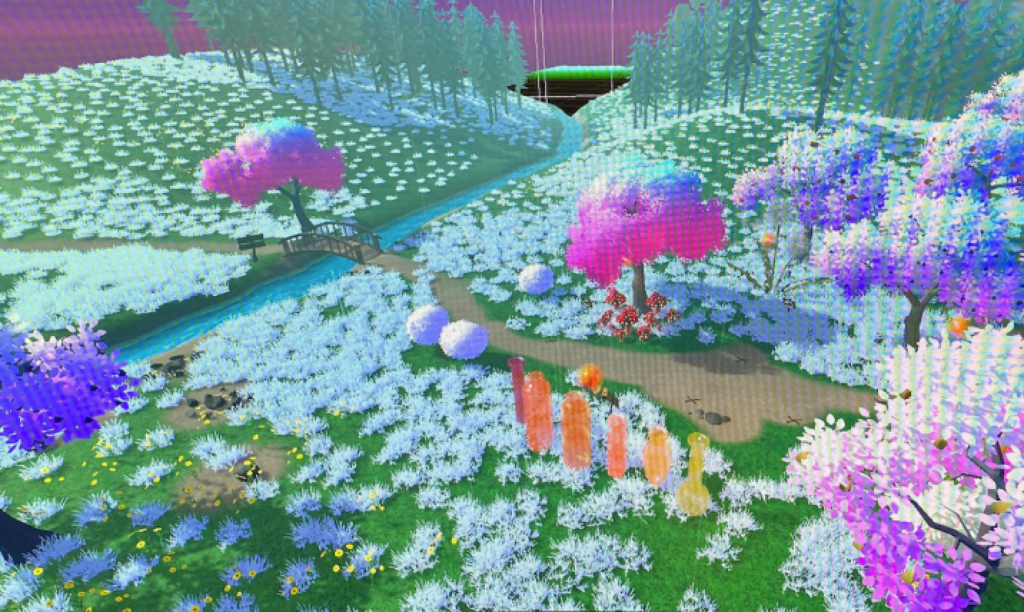
The first meeting I had was with Madina, a New-York based VR student at Parsons. In doing our initial image research, Margaret and I used her work as a reference for our VR world.

IMAGES ABOVE AND BELOW: Madina’s Extended Realities Marine Pavilion Project that was used as inspiration for our world.

We then set up a google meeting with Madina, who was extremely knowledgeable about the world build/spacial design aspect of our mindfulness- world, and agreed to help with the initial blueprint and design of the world.

Meeting with Madina

Madina’s involvement in the project not only helps me to focus on a more thorough research justification for the spacial graphics and the world, but also helps Margaret focus on graphically designing the gameobjects/user-interaction side of the world, while Madina focuses on the world/spacial- interaction and design side. It also helps reduce each of their workloads to manageable hours, as I’ve really emphasised to them that this research project is on a collaborative basis and I want to make sure that all parties are happy and comfortable with the time and hours that they invest.

The meeting with Madina brought up a few concerns that Margaret and I were already having with the delivery of the project, namely with the accessibility of it. One of my primary goals of the project was to make VR mindfulness more accessible, albeit that has now changed into more interactive- mindfulness, I still want to make sure people find it accessible. Hence, we decided to deliver the project in a 360- degree “web.gl” format (accessible on a laptop/phone), rather than purely developing it for VR. This would also greatly cut down the time it would take to develop the graphics and spacial design of the world, as web.gl projects have a maximum capacity on the resolution of the project. It would also allow people to have remote access to the experience, which would benefit in external stakeholder feedback, as I would be able to send them a direct link to the project. I would also be able to actually show people the experience as a “teaser”, so they would have an idea of what the project was about.

Although I counted more positives than negatives for converting the project to a web.gl version, initially I was quite doubtful of converting a project made for VR into a web- version, as most of my research on the interaction side has specifically been for VR. However, I was assured by my VR team that 360-degree web.gl projects could be accessed on a VR headset, similar to how youtube 360- degree projects can.

In theory, a lot of the justifications for why VR-interaction methods would translate to a web- version make sense- as a lot of VR- interaction has its roots in gaming, which has traditionally been on a web/phone- screen. Albeit, I will have to conduct further research into whether the interactions are truly comparable and whether they make my study valid.

Perhaps for further research it could also be helpful to create a comparative study for the mindfulness experience done on web versus with a VR headset on- and compare how the experiences differ.

The second VR creative I met with was Radina, who was a UAL graduate in MA Virtual Reality at LCC. Radina currently works within 3D modelling and particle system design, and has a lot of experience within the logistical side of the VR industries.

During our chat, the following pointers/notes came up:

  • 360 video is accessible friendly, webgl project instead of vr project make sense.
  • real time rendering takes time and too much processing speed, your project should not take more than 30 seconds to load a scene and the polygon count should not go over 300,000.
  • the first step is to have a plan of all of the objects and the world/narrative in a one- page brief for the VR creatives to start the build.
  • think about how many vertices there will be, will we have movement (yes)
  • Radina can help with textures/ resolution of textures/optimisation of textures – for a webgl project often time an enhanced texture can mimic a higher resolution without the technical drawbacks.  
  • Think about the visual effects and interaction
  • Having a duplicate of the VR and the webgl part, 2 sets of objects for VR and webgl, Radina can focus on the webgl and VR logistics and conversion.
  • It should take no longer than 3 minutes for people to experience it, both for the actual experience itself as well as the graduate showcase. In Radina’s experience projects lasting longer than 2-3min can miss out on a lot of showcasing/networking opportunities. A 2-3min meditation experience will also make more people more likely to come and try it during the testing rather than something that is longer.
  • Research shows that people get used to abstract experiences very quickly- there is a good chance that the world will not alienate them- look into abstract experience theory and research.  

My biggest takeaways from the conversation were the time for which my experience would last (initially I was aiming for 10 minutes but I can see how that may be too long), as well as the fact that I should be able to present my project to stakeholders during the final showcase in December and not feel like I have missed out on valuable feedback.

So far, I am quite happy with the developments made, as I now have a team to delegate each aspect of the project:

Sam: research and narrative

Margaret: assets and graphic design of 5 individual interactive components

Madina: spacial design and world build

Radina: logistics and conversion designs between VR and web.gl versions

My next steps are to deliver a 1-2 page brief outlining ALL design and narrative (mindfulness) aspects, alongside an updated research question to my team by Friday, 20th Aug.

Our next meeting as a team will be w/c 30th August, which is when we will establish a timeline for the final build of the world. Our deadline for delivery will be Friday, 1st October.

My project will be tested w/c 4th-8th October, to a sample size of n=25 (aiming for at least 5 people each day). Participants to be confirmed before 27th September.

19/07 Initial Image Research, Interaction Theory and Questions Moving Forward

This week I worked on more image research and consolidating the game world into an interactive space. One of the major questions I have been reiterating throughout the process has been the extent to which I want the VR world to be interactive- where in the spectrum between the end- user standing there and just observing the world to the end- user interacting with a playable game do I want my experience to be?

We also decided that instead of being sound directed, it would make more sense for the user to have the freedom of exploring the world, being able to explore their own space rather than being told what to do. In that way, it would make developing the experience a lot easier as events can happen concurrently without the user feeling like they’re missing out on a particular element.

(Screenshot of meeting breaking down the interactive space into “blocks” where certain elements will be present.)

A few more questions arose in our meeting which are integral to answer moving forward:

  • Where in the interactive scale do I want my experience to be? No interaction vs. full interaction
  • How many elements should I incorporate into my experience? (5-8 seems to be the most comfortable answer)
  • Should all the elements be interactive?
  • What kind of mindfulness elements should be incorporated into each “activity”?

Another main talking point was the visualisation of breath in our experience. Upon doing research I found that one of the most common breathing techniques in meditation involved the visualisation of the breath, most commonly as breathing in a certain colour and then breathing out a different colour.

Sources:

Micallef, C., 2018. Effects of Deep Breathing, Visualisation and Vocalisation on Levels of Stress and Anxiety 

https://www.mondaycampaigns.org/destress-monday/deep-breathing-visualization

https://www.sharecare.com/health/breathing-exercise-techniques/visualized-breathing

In our experience, I wanted to incorporate an actual visualisation of the breath after a breathing activity. Our initial considerations were warm, gold flecks of breath in and out, resembling Dandelion spores:

Initially we had wanted the “gold dust” to be triggered by the sound of the end- user exhaling, but then decided it would be much easier to do it with the timing of the exercise (eg. having it correspond with a physical countdown that the user could see)

Apart from the meeting, I also got in touch with Nexus studios, who do VR- based experiential marketing, in order to understand how a VR schedule worked (similar to a shooting schedule in film).

They also forwarded me to the BBC VR academy where I found more questions to keep in mind for the experience: https://www.bbc.com/academy-guides/virtual-reality-production-where-do-i-start

  • Be aware that when VR is designed incorrectly it can cause motion sickness in some audiences
  • Consider the role of the user in your VR experience. Are they a character in the story or are they an invisible observer?
  • Use dialogue, music and sound effects to steer users’ gaze within the 360 environment. Spatial audio is important to immerse users and guide them
  • Remember that each platform will have its own technical specifications to meet

09/07 University Access Meeting Notes, Testing Delay and New Proposed Timeline

This week I had a meeting with Richard in regards to the loan store and how I could make my project work to fit my research timescale. As the loan store would only be open from 27/09, I needed to reframe my timescale in order to make the most of the summer period in terms of making my research cohesive, tweaking the initial interventions and being able to straightaway test my final intervention when term starts up.

Moreover, my VR associate Margaret, who I am collaborating with has been having issues with her laptop which will hopefully be fixed by first- week August. Hence, we have decided to put a pause on the modelling/game design and focus more on image and textual research for the moment.

New Proposed Timeline and Checklist:

(x) = completed

13/06/2021 – 30/07/2021

  • Learn the basics of Unity and complete Modules 1 and 2. (x)
  • Conduct a thorough investigation into VR companies and research facilities in the UK that offer a mindfulness-meditation service, interview at least 5-8 experts. (x)
  • Create SWOT analysis of top 5 VR mindfulness companies in the UK and identify gap in market.
  • Get in touch with VR students (x) and create initial intervention plan. (x)
  • **URGENT – Check with the university whether the loan store is still open over the summer break, and also if campus and facilities are open all summer. (x – CSM Loan store NOT open over summer, follow up with Sion (x) and Annie and see if an alternative can be arranged. If not email Richard about potentially being able to test once term opens on 27th September) (x)

01/08/2021 – 30/08/2021

  • Develop intervention
  • Complete Unit 1 Flight Check Submission (due 16/08)
  • Get an RA to help with setting up each day.
  • Figure out incentive for testers – amazon voucher? etc.

16/08/2021 – /27/ 09/2021

  • Exposing intervention to external review – sending it to VR experts/stakeholders and taking their feedback on board.
  • 07/09 Unit 2 Presentation
  • What If? part addressed
  • Book rooms and headsets at CSM for testing period of 3 weeks (5×3 days), try to get at least 5> headsets and testers booked for each day (ideally n=50> total)

27/09/2021 – /10/ 10/2021

  • Testing of intervention and recording results
  • Conclusions from my project are derived and evaluated into a report

10/10/2021 – /31/ 10/2021

  • Comparing and reflecting on my research findings in accordance with existing secondary research. 
  • Feedback from stakeholders and experts leads to alternate considerations for informed research within the field. 
  • What If? part addressed

28/06 Stakeholder Meeting Notes (Design)

  • focusing on ambisonic sound
  • get in touch with VR designer from parsons
  • calm light environment
  • sound- driven narrative – sound is used as a trigger
  • nature/ambient sounds
  • calm light and shapes
  • environment recognisable
  • nature sounds?
  • animations – what do we use?
  • mushrooms / jellyfish – combining flora and fauna
  • particle systems
  • look into how fractals work – do they immerse people further? or do they alienate
  • turkish lanterns
  • fragile yet strong imagery – strength in gentle
  • everything has to look very light and thin

24/06 Research Update, New Design Stakeholder and Collaborative Spaces

Over the last couple of weeks I have been collaborating on my intervention with VR student Meg, as well as doing self directed learning. We have planned to meet 1x a week for now, and progressively increase that frequency in July/August.

So far I have identified a gap in the market for VR- based meditation, whereby most brands try to mimic real- world meditation settings, but my intervention will test how a fictional world can affect VR meditation.

After having spoken to Meg, she agreed that based on her experiences, fictional VR worlds are much easier to create as the designer is able to branch out creatively and the end- user is able to feel comfortable in a space that doesn’t “mimic” real life or seem Freudian. We thus decided to look at non- natural meditative VR environments, thus altering my research question:

NEW PROPOSED RESEARCH Q: How can artificial environments be implemented into mindfulness- based Virtual Reality experiences in order to provide tailored narratives that are unique to each user?

For the moment I have decided to remove biometrics from my project just to make it a bit more manageable (even though it was a really cool idea), but I may change this further into our experience development.

It feels really nice to be able to collaborate and get insight from Meg, as it helps us bounce ideas off each other and helps me understand what is feasible. So far we have set up a collaborative padlet space, as well as began the visual development of the experience:

These resources will be constantly added to and modified over the course of the next few weeks. At the moment I’m quite drawn to the world of Disney’s Soul and very inspired by the way they built the ethereal world:

I have also completed the first module in the basics course of Unity, and can now understand how to use the platform and the interface well enough to operate within a game – experience. So far I have created my own microgame which can be played here: https://play.unity.com/mg/lego/webgl-builds-63908

I will hopefully be finished with the next two modules in the upcoming weeks, as well as complete the rest of the tasks on my delivery timescale list.

Sources to explore:

https://link.springer.com/referenceworkentry/10.1007%2F978-3-319-08234-9_162-1

https://www.hindawi.com/journals/ijcgt/2011/282345/

https://www.ncbi.nlm.nih.gov/pmc/articles/PMC6974516/

https://www.frontiersin.org/articles/10.3389/fpsyg.2019.02667/full

https://www.sciencedirect.com/topics/computer-science/artificial-environment

https://naturetreksvr.com/

12/06 New Proposed Timeline for Research Delivery

After getting the feedback from my experts, I realised I need more time in order to fully think through my intervention. Although I’m passionate about this project and have been reassured that it is achievable for me to develop a VR experience intervention and test it within the summer period, I also understand that I need to:

  • choose one element of mindfulness to focus on, eg. breathing techniques.
  • learn two completely new pieces of software (Unity and Arduino) to help me carry out my project
  • have a comparison point to prove that a narrative VR meditation environment works better than a standard meditation environment (potentially contrasting 2 environments- VR vs non- VR)
  • work with collaborators on the technical aspects of my project
  • find a substantial sample size to help test my intervention over the summer period
  • ensure that the validity of my project is backed up by existing academic evidence

For this reason I have chosen to reschedule my project timeline, in order to make it more feasible for me to manage my research and development:

New Proposed Timeline and Checklist:

(x) = completed

13/06/2021 – 23/07/2021

  • Learn the basics of Unity and complete Modules 1 (x) and 2.
  • Conduct a thorough investigation into VR companies and research facilities in the UK that offer a mindfulness-meditation service, interview at least 5-8 experts.
  • Create SWOT analysis of top 5 VR mindfulness companies in the UK and identify gap in market.
  • Get in touch with VR students (x) and create initial intervention plan.
  • Get in touch with creative technology students and figure out whether a biometric- driven narrative experience is a bonus or unachieveable within proposed timescale.
  • **URGENT – Check with the university whether the loan store is still open over the summer break, and also if campus and facilities are open all summer. (x – CSM Loan store NOT open over summer, follow up with Sion (x) and Annie and see if an alternative can be arranged. If not email Richard about potentially being able to test once term opens on 27th September)

24/07/2021 – 13/08/2021

  • Develop intervention
  • Complete Unit 1 Flight Check Submission (due 16/08)
  • Book rooms and headsets at CSM for testing period of 3 weeks (5×3 days), try to get at least 5> headsets and testers booked for each day (ideally n=50> total)
  • Get an RA to help with setting up each day.
  • Figure out incentive for testers – amazon voucher? etc.
  • Exposing intervention to external review – sending it to VR experts/stakeholders and taking their feedback on board.

16/08/2021 – /03/ 09/2021

  • Testing of intervention and recording results
  • Exposing intervention to external review – sending it to VR experts/stakeholders and taking their feedback on board.
  • Comparing and reflecting on my research findings in accordance with existing secondary research. 

06/09/2021 – /27/ 09/2021

  • 07/09 Unit 2 Presentation
  • Conclusions from my project are derived and evaluated into a report
  • Feedback from stakeholders and experts leads to alternate considerations for informed research within the field. 
  • What If? part addressed

Sources:

https://mai.art/

11/06 Expert Stakeholder Feedback Notes- Annie and Sion (and Links to Resources)

Last week I managed to speak to two experts, Sion Fletcher from Technical Resources at CSM and Annie Wan, the course leader of the BA VR course at LCC. They were extremely helpful and were both optimistic about my research goals from my proposal, and said that it was definitely achievable to learn how to use the VR software to create an intervention and test it for the August deadline.

SION MEETING NOTES 

Basics: 

  • look into interaction design 
  • narrow the topic down, tackle something smaller than just mindfulness
  • breathing exercise VR – breath in white smoke and breathing out black smoke (maybe monitoring breathing with microphones??)
  • room J206 – csm 

VR Technical stuff: 

  • focus on vr technically 
  • game engines to use are unity and unreal (unity is easier to use), the physics system is the same – physex for both AND THEYRE FREE TO USE 
  • Do unity courses to get an idea, go through fundamental courses
  • play around with an actual headset 
  • stuff you need for vr is just the same as any other monitor 
  • navigation, tracking of headsets, interaction between user and game 
  • libraries of free software on unity physics system – particle systems – rendering engines -materials 

Biometrics: 

  • arduino sensor heart rate 
  • serial port signals in unreal 
  • sketch out certain ideas about things i want to create 
  • get ideas from the tools you use as much as the other way around 
  • don’t fixate on an intervention just yet, give yourself time to play around

Possibility of MR: 

  • hololens is an option BUT MR isn’t as cool as VR
  • don’t be limited by MR, VR is a better option for idea 

ANNIE MEETING NOTES: 

  • loads of info/research on vr and meditation 
  • VR meditation does exist 
  • maybe a calm environment with trees and wind?
  • create outer space environment that doesn’t exist (INTERESTING)
  • bringing people away from reality makes people calm
  • am i heading in a humanities research? look into comparative research 
  • real world vs vr meditation environment 
  • technically IT IS feasible and there are similar applications that exist, I need to identify the gap in the market (possibly bio-driven VR?)
  • oxford vr department (therapy) does a lot of research into this
  • not data science project, user experience research project 
  • unity guided meditation exists, have a look at it
  • your ultimate goal is humanity, not technology 
  • sensory inputs/data is an add on, not the main focus 
  • there’s different levels of meditation/mindfulness
  • why do i have to use VR? Identify the WHY
  • Am I filling a gap in the market? or gap in research? 

USEFUL LINKS SHARED:

https://psious.com/

https://www.oculus.com/experiences/gear-vr/929143807179080/

https://www.wired.com/story/virtual-reality-therapeutic-benefits-travel-socializing-exercise/

https://www.solasvr.com

https://www.oculus.com/experiences/gear-vr/929143807179080/

NEXT WEEK’S TO DO:

  • research into market competitors that already exist, make a SWOT table
  • get in touch with smaller VR companies based in the UK
  • learn how to USE unity, apparently it takes 2/3 weeks to learn how to make a basic game/understand the interface
  • get in touch with VR collaborator, perhaps student from LCC
  • get in touch with Arduino collaborator, see if something other than heart rate might be a good option or whether it is needed at all – also see if there’s a way to use Unity and Arduino together.
  • Replan project schedule in accordance to Unit 3 study guide

https://www.fastcompany.com/3058756/why-virtual-reality-will-change-design-forever

31/05 Admitting to not knowing anything and (finally) reaching out to people who can help

I think my biggest issue with reaching out to stakeholders is always based on an underlying assumption that I should know everything beforehand so they actually take me seriously – perhaps it’s an age thing or the fact that their experience outweighs mine and I feel an complex need to prove myself in order to be listened to.

Which is probably good in some way because it keeps me accountable and motivated towards my research goals, but it also creates an immense anxiety of “what if I missed that one website on one particular topic” and not being confident enough to actually reach out to them.

Over the last week I’ve made a conscious effort to look back at my old research notes in the same headspace I was in when I worked on them- and realised how fun it was to actually not know anything and jump feet first into a research area. It’s a bit of a scary experience now, but at the time I remember being so excited to do research within VR and actually have fun doing it, knowing that I could experiment and had nothing to lose.

That being said I’m trying to apply that mindset to the way I approach experts, by expressing that I’m interested in the topic but also being objective in my lack of prior experience within it.

I definitely think the more experts I talk to and the more people I get involved within the project, the more my confidence and creativity will be boosted in terms of achievable goals for this project.

I’ve also seen other people ask the course chat for advice regarding their question, which I really appreciate as it seems to make the process a lot more collaborative and really reaffirms the support we have within the cohort. Perhaps this is a step I should take as well, as there might be a gold nugget insight that may help me with my question and project.

Decolonising my entire brain

After nearly 2 decades in education I’ve only just realised I research like middle- aged white man.

Which might be fine for academic practice because the whole world is subconsciously hardwired that way from the moment we start kindergarten– but it also makes my own views of research feel illegitimate sometimes when I notice a cultural gap in who I’m consuming research from, or if my personal experience has been different to what’s been published in a journal.

Things to consider while doing research:

  • Is my research accessible?
  • Is my research inclusive?
  • Is my research conducted through a masculine lens?
  • Is my research conducted through a heteronormative lens?
  • Is my research ableist?
  • Is my research ethical?
  • Does my bibliography have a good ratio of POC researchers/researchers who get their info from more than just one part of the world?

Couple more that could take a lifetime to find the correct answers to but important to consider anyway:

  • Have I presented my research in a way that is truly non- biased? Is that even possible?
  • If not, what are the steps I can take to ensure that my research is actually considerate and not somehow harmful to the reader?

This MA is hard; a ramble

(Preface: Tutor reading this – sorry for the non- academic tone of this entry, i just needed to blab what was on my mind)

I’m only now realising that this MA is actually really quite difficult.

It’s not the content or the tasks we’re expected to do, but more so the way I’m having to constantly reconsider how I work as a practitioner, or whether I can even call myself one.

I’ve openly expressed my feeling of impostor syndrome in lectures before (since then it’s been brought up by almost everyone else in the cohort as well), but I don’t quite understand if it’s my lack of understanding of the (very hard) research question I’ve chosen, or if it’s my own insecurities in terms of actually being a good enough researcher.

I’ve also realised that for most of my academic career my job has been to embellish the words and findings of someone else and hope that a structured compilation of different people saying the same thing will inherently prove my point and make me a “good” researcher. Whereas now I find that if I only go by what someone else has found I don’t make any real contribution at all, and my own work and place in academia becomes a load of BS*.

(*sorry i know i’m supposed to mind my manners but this was the only apt way of describing what i’m feeling)

It’s also been a massive change going from group projects into suddenly being thrust into major individual research, and it’s only now I think that I understand how isolating being on a course like this remotely can be, I feel like I’m the only one struggling with my research question and having to rethink my entire proposal and project for Unit 2 and having to start from zero again.

Albeit I have made some great friends on the course and we have conversations like this that make me feel a lot more reassured about where I am in my research stage:

(Context: The lecture about how to actually make an intervention two weeks after we’ve already submitted our proposal)

Also this sounds a bit sadist (and I promise it’s not) but I really appreciate people in big lectures being open about themselves struggling too, it really does help me feel like a massive pressure’s been taken off my shoulders in knowing that we’re all kind of in the same boat and that I don’t have to unearth a mind-blowing world- changing piece of new research right this second (even though it would be really cool if I could).

Over the last weeks I’ve really been trying to push through with my research question and find a way that I can conduct the research feasibly and not have to compromise on the process and still be passionate about the topic, but it’s really really difficult and I feel like I end up with more questions than answers and more doubts than assurances.

I’ve started to work backwards in my process, using old journal entries and powerpoints from old presentations to see what areas of VR research I was actually interested in, and why I chose this topic in the first place, rather than being overwhelmed by not only my own process but also the varying feedback I’ve received from different tutors, friends and coursemates.

That being said I’m thinking of completely reevaluating my research question and focus and finding something that uses an intervention as a tool, and not an outcome, and finding a way to make it less of a data science project and focus more on human behaviour and find validity in the qualitative outcomes. It’s a bit of a blow to my big ego as I sometimes feel like I’ve diminished my existing research and the last month has been a waste of time, but concurrently it’s also put me in the mindset to actually take time to learn about VR as a craft rather than as a research focus and look at it through its market value. I’ve also begun to question how I want to approach my own relationship with VR after university- do I want to be an artist? A research practitioner? Or a commercialist?

I also need to make sure my research has minimal ethical worries (yes I have the words biometric data in my research question but I do I even completely know what that means? NOPE.).

In the meantime I think I quite like how the change of tutor between the two units has affected me, I’ve been exposed to two completely different facilitation styles and both have been really helpful in different ways.

Helpful sources to explore for future sam:

  • Technical moodle and consultations

https://moodle.arts.ac.uk/mod/tab/view.php?id=460290

https://outlook.office365.com/owa/calendar/JooAlvesMarruchogeneralbookings@artslondon.onmicrosoft.com/bookings/

https://10to8.com/book/toglohsugluvvueajb/

https://www.arts.ac.uk/colleges/london-college-of-communication/people/annie-wan